
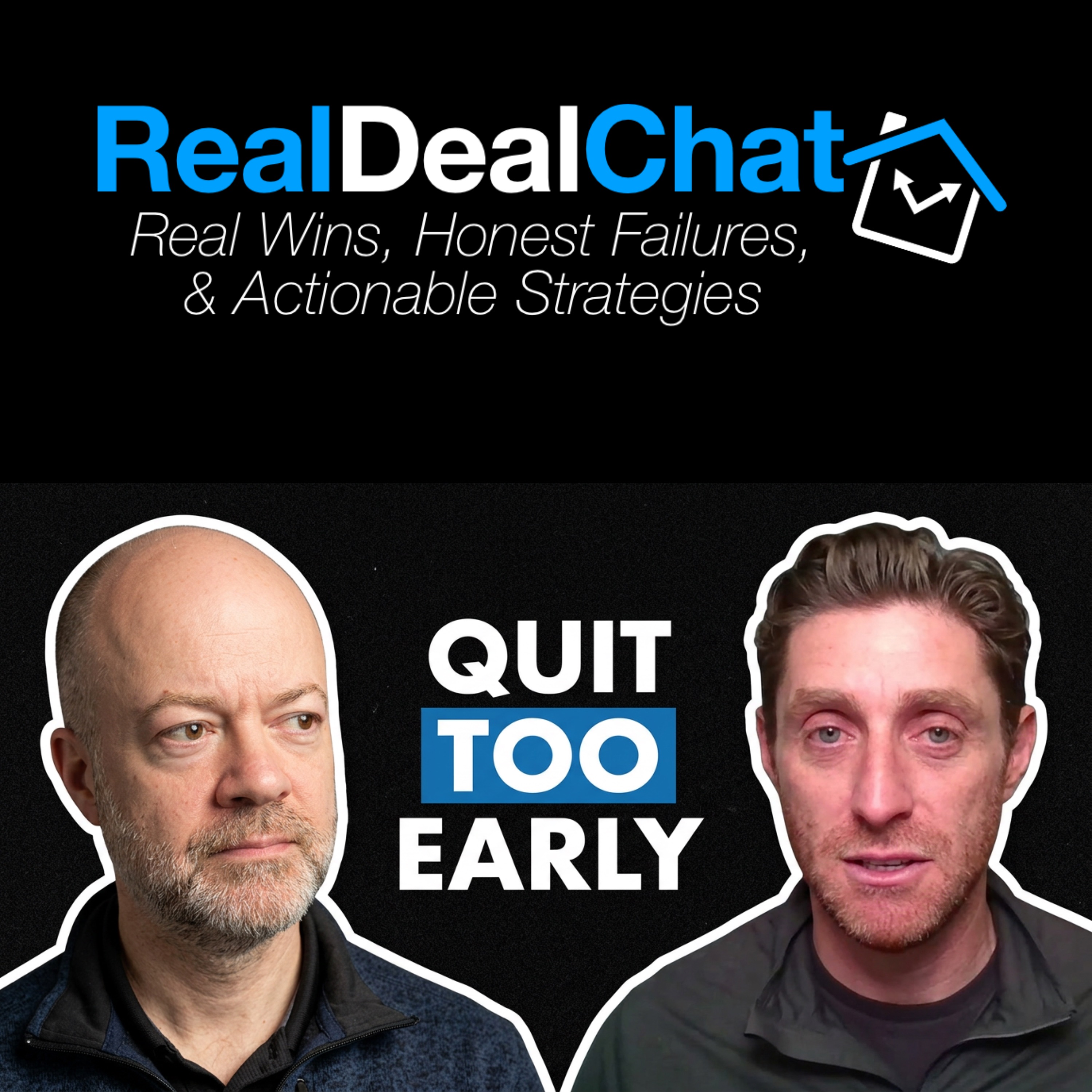
Why Most Investors Quit Too Early w/ Joshua Gould
Listen
Show Notes
Most investors blame bad timing or lack of capital. Joshua Gould says the real reason they fail is simpler: they quit too early.
Joshua Gould bootstrapped a language services company from nothing, funded it by selling real estate, and scaled it to serve governments, courts, and hospitals across more than 50 countries before selling to private equity in 2021. Now he invests in commercial warehousing in Miami and applies the same frameworks to real estate that he used to build and exit a global company.
In this episode you will learn:
- Why most businesses and investments fail not because the idea was bad, but because the operator quit before the roots were deep enough to hold
- What opportunity cost really means and why most investors never calculate the true number
- How Joshua's father's biggest regret -- selling real estate to fund the business -- shaped how he holds assets today
- How to use AI to build a pro forma, stress test a deal, and pressure-check an offering document before you commit capital
- Why the data never lies, but the story built around it usually does
- The three types of people every investor network needs: connectors, gatekeepers, and experts
- The one question to ask before investing in any fund: why aren't they going to the bank?
Joshua runs TheBigWord.com, a language services platform operating across 50+ countries. Find his mentoring content on YouTube at ExecCraft.
Work With RealDealCrew
If you’re already closing deals but your intake, follow-up, or visibility feels inconsistent, here are two ways to go deeper:
Take the Deal Intake Assessment
See how resilient your current operation actually is.
→ https://assessment.realdealcrew.com
Book a Fit Call
If you want to explore what a fully system-driven deal flow looks like, let’s talk.
→ https://realdealcrew.com/book
LIKE • SHARE • JOIN • REVIEW
Transcript
most people will give up. before they are successful, which is the number one reason why business fail Most investors will tell you they need more capital, better deals, or better timing. Joshua Gould bootstrapped a company from nothing, sold it to private equity, rebuilt his real estate portfolio, and says the real problem is simpler than that. Most people just quit too early. In this episode, you'll learn how Joshua found a business by selling real estate and what his father's biggest regret taught him about never letting go of assets.
Why opportunity cost is the investing concept most people completely ignore And how to use AI to stress test your instincts before you commit capital. Joshua runs TheBigWord dot com, a language services platform servicing governments and courts in over fifty countries. Check out real deal crew dot com for tools to build your investing business and let's get into it. Joshua Gould joins me here today. And I'm going to direct you to his YouTube channel.
So look for execcraft. I'm going to have that as a clickable link in the show notes so you can go right over there. You got your first season of this. This looks like some great content, especially around three businesses you can start that AI won't kill. I'm sure there's some hot topics on there as of late. Yeah, I do quite a bit of mentoring for investors and CEOs and I have mentors and I always
joke with them. say, I wish we could just record these conversations because I actually think they're good value. You know, so I started just doing the talking head piece myself. It's easier than what you do, Jack, in many ways. And I hope to do interviews sometime soon on the ExecCraft channel, but thanks for pushing it out for me. yeah, you bet.
Well, there's some of this is, you know, your primary business is the big word.com, which is kind of an AI translator. Would that be kind of in a nutshell what that what that solution provides? Yeah, so we provide language services to governments and public sectors so they can communicate with their populations, whether that be in a prison, hospital environment, a court system, police station. So it's mission critical. Works like Uber, we can provide on demand people in the real world and we do it digitally
as well. So where we have real people on video, real people over the phone, but we also have AI. avatars doing the interpretation and translation, interpretation being the written word and translation being the spoken word. And this was bootstrapped 20 years ago by selling little bits of real estate that we had. And, funding it through a very small real estate portfolio. And thankfully we've been able to build our real estate portfolio back ever since we
actually sold the company to private equity in 2021. That's really interesting. So you would have had to been have a very clear why associated with that core business for you to start selling off your real estate to accomplish that goal. Can you talk a little bit about that process of what you went through to establish that mindset and, and make that level of commitment? Yeah, I don't know if you've ever heard of the Chinese bamboo story where it's a magic bamboo tree, you plant it and it takes years and years to develop on the ground and then
one day after five years it sprouts a small like little one foot tree but then within six weeks it grows into a 60 foot tree. and everyone looks at the bamboo tree and thinks wow look how quick it grew in just six weeks it's gone from nothing to sixty foot but the person who had to water that every single day had to turn the soil, had to fertilize the soil understands that that actually was five years worth of work and business is very much the same. You you have a vision, which is really like the seed, and then you have a strategy, which
is like the fact that you got a water of this strategy every single day and you don't make money in most businesses straight away. In fact, most companies won't make money in the first two or three years, even when you're bootstrapping them, you've got, you know, unless you've got an investor who's gonna, you know, give you millions of dollars and allow you to take an income and people do that. But in our case, we bootstrapped it. So we had to look for ways to fund that. family business and my father had spent years building up a very small he came from
government housing if you knew Europe that would be public sector council housing and he always had kind of kept his lifestyle at a very low cost level so you could buy this these different apartments and they weren't especially nice or big apartments, but they would give an income. But at some point when we really thought that this little seedling was going to grow, we decided to go for it. And he started selling some of his real estate to fund that. And the first thing we did when we made money back was to acquire our own office space and
then build more office space. And then when we needed even more office space, we rented that out and we built a new site. And the biggest regret my father says he's now well retired is he wished he never sold the original office space. In fact, he wished he never sold any of his real estate. I hear that quite often, you know, we're, eventually going to get into the rapid fire questions.
But one of them is, if you could go back in time and give your younger self one piece of advice, what would that be? And more times than not, I that's typically the answer I get is people regretting selling their real estate. Yeah, I think it's one of those things that we don't look at opportunity cost very well. Whether it's in business, whether it's in real estate, whether it's even in your personal life, in a relationship. You know, how many people have been in a relationship in their early 20s too long when
really that was the time to, you know, go and try a lot of different things out and do a lot of different things. I do though think that people when they're looking at any investment, whether it real estate, whether it be looking at business, you've got to look at opportunity costs. So I hear people say, I haven't invested any money into my business. I went out and I got investors and I say, but I would have paid you $350,000 base a year and you probably would have earned half a million dollars a year working on my executive management team.
And you not taking that and taking a low $150,000 $350,000 in you know salary from your investors means you are investing $350,000 of your own money into the business every single year plus if it doesn't work Then you'll never get that time back again, and I think that applies to real estate as well And it's all a calculated risk. You know you have to believe in you know, the warehouse that you're about to chop up into smaller warehouse spaces and rent out.
You have to believe in the multifamily home that you are buying in. You know, it might be a class C place and you believe it's a class B area. You know, see, there's a lot of belief in this and, you know, I think technology can play a role to try and test people's instincts. It won't replace people's gut feeling and instincts, but you can use AI, which I use in my business all the time to crunch the data and really test out the models and what could happen. Well, there's a lot to unpack there.
The first one is, is that you mentioned that even when you bootstrap, you could take three or more years just to become profitable. What does somebody have to like, let's talk a mindset a little bit what somebody has to kind of shore themselves up to withstand that those lean years and that you're you have the confidence to come through the other side, you've already given an example of maybe using AI to help you kind of stress test these ideas. But maybe there's something else besides that. Yeah, so most people don't, is the truth, Jack.
You know, most people will give up. before they are successful, which is the number one in my opinion, because it's anecdotal, I can't prove it because I can't say what would have happened. It's the number one reason why business fail is they give up before they're successful. I've had a business called Writers Out, it's wildly successful in its first couple of years, but it didn't make any money. It was a publishing company, a self publishing company about 16 years ago. had 18,000 people published and self published for the first
two years but we're losing money so we shut it down that's my greatest regret in business personally and the reality is is that people will close them down or they'll do something else they'll create themselves a job so imagine you're a plumber and you are working for a big agency and you decide to go and set up a loan so you buy van and a truck and you're doing the un-plumbing yourself and then you have a choice right when you've got more work than you can handle do I then go and take the second truck and the third truck and the fourth truck and I'm no longer being the plumber and I'm not making any money then because I'm I'm buying these trucks I'm doing the marketing I'm
answering the phone and I'm going from you know a guarantee $200 an hour which is what we would pay here in Miami for a a bad plumber, know, a good one might be $300-400 an hour. And I'm giving that up and I'm giving it to these other people and investors are very unselfish. And I have a good friend in the real estate game and he says, if you want a really, really good get rich slow scheme, go into real estate. And, you know, I asked him, well, have you ever seen a good get rich quick scheme?
Of which he answered, yes, the lossary. And it is true, you know, it really is the only get rich, get rich quick scheme that's almost guaranteed to work if you win it, but you've to win it first. And I don't like those odds. So the key here is, yes, you can use AI, yes, you can use telemetry, know, like all this data that comes through. But the other side of this is you need to give yourself time because unlike the bamboo story where the seed is finite in strategy and business, everything around you changes and
you have to change with it. So you evolve a strategy. You don't come up with a strategy and rigidly keep to that strategy five years later. You evolve it and therefore you can create checkpoints. So when we develop technology, We don't expect it to be a billion dollar technology idea on day one. We on day one just expect to understand the general direction we're trying to get to. Then we're specing it out and then we create these checkpoints.
So first checkpoint is can I create a minimum viable product? Then can I go from the minimum viable product, you know, through to say a product that's more commercially viable? And then when I've got my anchor client, can I get two or three more clients on there? And then your four is, can I scale this? Your five typically is, I've now scaled it. How do I make sure that I capitalize on this and I make money on this? you know, so now you're already five years in and you're to spend another five years
capitalizing on it. By the time you come to sell it, you've done this for 10 years. So time is the answer. Time is always the answer, Mm-hmm. So yeah, another thing that you said early on here is, and that I really like is that you mentioned that you could take a job for 300,000 and then but now you're going to start a business and maybe make 150.
You got to start to see that as an investment and a commitment into your business. I see this quite often, especially people who get into real estate investing for the first time, they might be flipping a house, but in the end, they don't take into account the time and effort that they put in and they essentially kind of created themselves a job. Like, can you talk a little bit about that? Like, is that something that was ingrained in you early on? Or is that a mindset shift that you had to go through to see that as an investment like
you do? Sure, yeah. I think it is a mindset. And I think it was ingrained into me as a child, I had a father who was a struggling entrepreneur. And even when he made money, he didn't just go and buy an amazing car, an amazing house. It was always reinvested and churned. And I think that...
The mindset here is, I want an income that is essentially selling my time? And people with their own businesses can be selling their time. It's not just employees of companies. People who are flipping a house could be selling their time. know, if all you're doing at the end of the day is selling a house, making a profit, living off it, you're selling your time. You've not got an asset. What I believe in and what I focus on is trying to invest in assets, whether that be real
estate, and we do have a real estate fund and we buy commercial property mainly, and also in businesses. And those businesses should outlive me and the real estate should outlive me. And I'm going to make a little bit of money every year. So if I'm investing in a business and I'm actively working in it, I need more money because I've got to value my time. So my return on investment has to be around 25%.
But if I'm going to buy a multifamily home and I'm going to pay someone to manage it, and you know, then I'm only looking for it to kick off two to 3 % a year. As long as like the I believe in the value growth as well of the how of the multifamily home that it should be around five percent a year and you know that might be eight percent a year. If I then got to say improve that multifamily home I'm taking new risk and I'm now investing my time. So then I need my upside to be closer to 15 percent a year.
Why why 15. Well it's not as risky. a business. When you buy a business it's very easy to end up with nothing. When you buy a multifamily home, unless you're really overly leveraged, it's hard to end up with nothing. So it's all risk versus reward as well. But you have to put a value on your time and ultimately your goal is to get income whether
you work in the asset or not. It's a fallacy that you won't manage it. You manage every asset. I know I have billionaires on my board. They're still every single day waking up and all day long managing their assets. And sure, they've got loads of number twos, loads of number threes. They have people to cook them food and to drive them and to fly their aircrafts. But they're still working really, really hard, as hard as the person that has three
different jobs. but the difference is their assets will outlive them. And if they want to stop working, they're still going to be pretty wealthy. Just to remind everybody, we're talking to Joshua Gould. You can find his YouTube channel. Look for execcraft. I'm going to have that as a clickable link in the show notes. If you found some value in what we're chatting about so far, do us a favor.
Share this with one of your friends. If you're watching us on YouTube, give us a like and subscribe. So Joshua, let's spend a little time on your commercial property investing. And maybe how that overlaps with your core business. Is there integrations there? Or maybe you're buying into the big data centers that are popping up lately and that's hot because of the whole AI trend. Yeah, so there's not much overlap and I do think in investing you get to a point where you
should be diversified. But in terms of lessons, learn and strategy, there is a ton of overlap. Let's just put the technology aside for one second. Most people, when they get into real estate, they have this picture of what a real estate tycoon looks like. Usually driving a Rolls Royce, going around and visiting their properties. And the reality is it can be like that, but it's not going to be like that in one year or two years or three years.
And whether you're... investing in a business that's not real estate or real estate, you are probably going to have to raise money in order to speed up some of the results. So You know, I have debt in my business and I have equity investors. And when I do real estate investments, I look for the same. So I'm looking at warehousing at the moment. I believe in warehousing long term.
My thesis is that people will continue to buy more and more online. The economies will go up and down and the economy probably will go down for a little bit, but it will go back up again. And I'm a long term investor. So I'm looking 15 to 30 years ahead. and I think that know warehousing is just a solid business so I'm looking at warehouses that I chop up. make smaller.
the smaller businesses that I think will be huge beneficiaries of AI are going to pop up, you know, all of a sudden that person that sits in a warehouse and makes kitchen cabinetry can become a guru in marketing because of AI. They can become a guru in selling. They can have people to answer the phone in whatever language you want. And I think that that's really good long term. So I'm looking at that and I'm, you know, applying the lessons of business. This is long term.
This is hard. You're going to have to look at hundreds of deals to get one done. The deals you don't do are often better than the ones you do do. The investments are uncertain and the environment which you buy this product in will not likely be the environment you're going to sell the product in. So you've got to start looking at data and where it's going. Then you look at all the and this is the amazing thing.
You don't need to buy a lot of data now. You don't need to be a guru in technology to run prompts like what's the net migration into Miami where I invest. I'm looking at that on Claude or Chachi Bt or Gemini and sometimes I'll let them argue between each other. What's the net migration? What's the traffic patterns like on I-95? And then I'll just ask it, how far away from I-95 is too far for a warehouse investment?
And it's amazing what it can tell you. So knowledge is now being commoditized in In real estate, that's the cool thing that a lot of people can acquire this knowledge very quickly through a command prompt on AI. But what you don't have is experience to apply that knowledge. So that's the other thing is when I invest in a business, I'm looking at people who can apply knowledge, who have a gut instinct and then can use data to check it out. So I don't like to do this on my own.
I've got a friend who knows all about this. He's much smarter than I am. and he's done tens of these deals and he's made a lot of money in these deals. And he'll come along and he'll say, yes, but, and I would have thought about that. And Chachi BT had no idea that there was a rezoning about to go on a mile away and someone's about to build a huge facility there that everyone's gonna wanna be there or a new train station's coming to Aventura, which is North Miami. So again, I'm applying all these lessons, but in a nutshell, just for your...
audience to take away. Knowledge is being commoditized. But the experience of how to apply that knowledge cannot be AI cannot do it can fake it, but it can't really do it. So I look for those people. And then I also understand that the market I'm buying is not going to be the market I'm selling into. And each market a down market has an upside and up market has an upside to
So I'm not trying to time the market and therefore cash ultimately is really important to me, which may surprise you Jack with what I said earlier. It is important even when I'm not making it. I'm looking at kind of the projections, what's gonna happen now. Well, I might not make any money on it. I may lose money on it, but what's gonna happen in three, four, five years time and I'll pro forma everything out long term. So if you don't know what proforma is, you're estimating what's going to happen in the
future. You're building out a financial model that will tell you how much money you're going to make in one year, two years, three years, four years, five years. And I'm proforma-ing the costs out as well. So I know the inflation in electricity is probably a lot higher than CPI. And I can find that information on Claude or Chachi BT or Gemini and I'll build out a pro forma. And if you don't know how to build out a pro forma, you don't need to anymore.
Again, you go back to your AI and you deploy that technology and you say, please build me a pro forma. These are all my numbers. This is what rent I'm getting today. This is what rent I expect to get. This is the level of occupancy I expect to have at the end of the first 12 months, pro forma out five years. and it will pull tremendous data.
You've no idea where the data is coming from, but it's tremendous amounts of data. All of a sudden you're getting all this information and then you can take that to your investment base. And I love country club investment groups for real estate. It's amazing. You can, if you have a friend or do it with someone who belongs to a country club, they don't let me in country clubs. I'm not country club material, but...
Again, I have a partner who can do that and he can get a deal funded in an afternoon in a country club. Everyone froze in 50 grand. You know, you've got your first, you know, million dollars and you can now go and complete that three million dollar multifamily project. You've kind of alluded to that a couple times on the importance of finding complement al partners in different aspects. Is that one of the tricks when you've that you've learned in scaling?
I mean, you your company right now has quite a few people that work. They talk a little bit about that. Yeah, so actually on my last episode of ExecCraft, I talked about the three types of people and the shadow hierarchy of my own business and many businesses. The first being the connectors, and I'll come back to that. The second being the gatekeepers and the third people being the experts. And you need all three. You know, all three are really, really important, but the reality is, Jack, and I didn't
share this on ExecCraft, but they don't have to work for you. You just have to know who they are. You don't have to be an extrovert. I'm not an extrovert. I hate going out all the time. I'm not scared as well of my own shadow. I'm somewhere in the middle. They call them an ambivert now.
But I know who the connectors are. I know who the gatekeepers are. I know who the experts are. And I go to each one of those. And when I build teams, whether it's for real estate, whether it's for just general business, I'm trying to build a team with all three of those in who can get me through the gate or close the gate when it needs to be closed.
You know, these are the people that have the information and they call them gatekeepers for a good reason of close the gates when information shouldn't or can't get out and they'll open it for you when you need it opened. Then there's the connectors. So you need a plumber, you need a, uh, an electrician. You need, you know, whatever you need, they know. And then, you know, and then you have the experts, you know, the people who, you know, they've done 10 deals just like it in the last five years in your area.
And you'll be surprised. Most of them are willing to share, especially in real estate. It's one of the friendliest industries. Everyone can be competitors, but they are also really happy to share and talk about it. And if you think about it, the markets are so local, there's a good reason that they do that because You know, they don't necessarily want more competition, but more competition makes their assets more valuable as well.
I can't agree with you more. I've I've mentioned this multiple times. It's it's one of the most shareable group that I've I've ever been involved in. You know, people are more than happy to give you a hand up or share information or, or what have you. It's, it's actually seems to be uncommon compared to most other professions I've had over over time. Yeah, I went to a pickleball tournament sponsored by an evictions attorney just a few
weeks ago. And you had all these people that were kind of doing the same thing to varying degrees. Some of them had built up portfolios of many hundreds of millions of dollars and others had just started out and they may have 20, $30 million portfolios. but they're all helping each other, they're all talking, they're all giving people information and I'm thinking to myself, that wouldn't happen in the language tech business. Everyone's guarding every single secret and maybe that's wrong because it might help in
the short term to guard your secrets but there is such thing as industry growth. You you'll see this in like the milk industry or... you know, commodity based industries where the whole industry gets together and does advertising to say you should drink more milk or actually sugar isn't as bad for you as their first four, you know, the real estate industry does that really well. I would imagine that if anyone listening today hears this and writes to say the CEO of the top five real estate companies in your area of real estate that you're focused in, whether it be builders, whether it be
flippers but if you write to the CEO or owner of those companies asking for a coffee I'll bet you at least one maybe all five but at least one is going to go out with you for a coffee and if you were to go and buy that same advice in the language tech industry you'd be paying somewhere around seven thousand dollars for the coffee but you're gonna get it for free in the real estate business it's a nice business Yeah. Well, you know, we've already kind of talked a little bit about this. But since you have your core business is what it is.
I have to ask you some questions around AI technology and a few other things, especially around the operations aspect of real estate investing. First off is what's one thing that people get wrong around AI and implementing it in their business? This is an easy answer because it's very obvious. It's well spoken about and that's AI is an engine. It's a robot if you like. And I don't know if you know anything about cars, but let's say you buy a crate engine,
which just means it's the engine of a car, but it's inside a box. It can not do anything without the wheels, without the steering wheel. And even if you put it in your car, but you don't plug, the gas into it and you don't get the timing belt right and you don't ensure that the injectors are working properly and you don't plug in the ECU to the computer, which is the computer, none of it can work. It's useless. And so that's the misconception is that I can just buy an AI engine and build some kind of
AI company around it. You can't, you need data. Now I've just told your audience that you can go on to Chagy BT, Gemini, Anthropics, Products, Claude, and put all this in. They are scraping the world's internet. That's what large language model means. It's using, you know, a lot of data, but there are AI systems which are neural machine learning, which is what we are talking about.
but they don't use large language model. They use small amounts of corpora, which is data. And when you feed that in, you get an edge. And that's the bit where the real magic happens. So you're going to start to see a lot of real estate companies saying, we've got data that no one else has. We tuned our products. We're orchestrating data.
This is all terminology that you're starting to hear. There's a company called Reventure, which I like to use. and it's a real estate data company. But if you ever look, they're just getting their data from the same places you and I could. They just have a nice interface. And for me, that's worth paying. But the real money is in the data and the real failures in AI programs and projects is not
giving the robot the access to the data. When I was looking at your YouTube channel, I noticed that one of your videos kind of took off and it was the data doesn't lie, but the story around it usually does. What is the content of that video? And what what do you think kind of resonated with the audience? Well, I made that out of frustration. I sit in a lot of meetings and people try and convince me of, you know, I'm CEO of the big word and people try and pitch me on things or convince me of things.
We should go into that geo location. We should invest in this product line or this technology. And they typically will weaponize data in order to make their point and get what they want. And I realized that I can take the same data set and tell two, three, four or five different stories. And some of them will actually be working against each other. So I wrote the title down after being on one of these calls and it says the data doesn't
lie. I can't remember the exact title that you just mentioned, but the story around it often does. this is really a warning for people of don't If you're to use data, don't use it with preconceptions and don't be lazy about decision making. If you are going to allow the data purely to make the decision for you, you are not needed in this equation.
And that's why I'm saying you need to understand who in your industry, if it's real estate and then real estate is not just an industry, it's segmented into lots of You've got multifamily home and then you've got the facility management people. You know, there's so many segments in real estate. So find the people that really understand it because you're going to have to, you know, have help to apply the data in the real world. And for that, you people with experience and people who don't just have the knowledge, but have the understanding.
That's what that video is about. Yeah, it kind of goes back to what you were talking about building your pro forma. Because I never take people hand you performers all the time regarding whatever investment property or they want you to buy something. And I always see it as fiction, for the most part, until I run my own stuff. And thankfully, with AI now, boy, that's that's really changed the game on some things to to build something out and just to validate it before you you proceed. Don't don't take anything at face value.
Yeah, I I work with some of the most sophisticated investors in the world, some of the biggest investors in the world, and I can tell you they're doing just that. And you can do it in your own bedroom now. You can can import a what's often called a SIM, you know, which is a confidential information memorandum. And that's like the book when you're looking at a real estate investment that you get, you know, in real estate, it's often called an offering. And you can put that into AI, you can just upload it.
You don't have to do anything clever with it. Just upload it and say, Please find me all the holes. Do a deep analysis. And again, the prompts are really important because you can actually say, what do you think of this? I don't put that in as a prompt. I'm trying to look for the holes.
I'm trying to disprove it. I don't know if you like boating, Jack. I'm a big boater. And when I buy a boat, I find one that's irresistible. And irresistible means too tempting to resist. And then... pull it out the water and do a survey and I will try and find every reason not to buy that boat and only when I can't find enough good reasons for the price then I will buy the
boat. Because even then by the way it's not going to be plain sailing I'm going to be in the middle of the ocean at some point my engines going to cut out. I'm going to need to call CITO and investing in real estate is the same right you can have on paper the most beautiful investment. but it's not going to be easy if everyone would be doing it and they wouldn't need your money. They would just go to the banks.
That's the other thing that I encourage everyone to ask. If you're to invest in someone else's fund, why aren't they going to the banks? The banks are smart. They're really good. They have a lot of cash to invest. At least the high street banks do. If they're not investing, you have to ask yourself why. Now it's not necessarily a real bad thing if they're not investing because they have a set
of rules and they're looking at risk differently to you and their profile of investment is going to be different to you. But you still want to know why. Why can't you go to the bank and get this money if it's such a good deal? Why can't you go to the bank and get the money? there'll be reasons. Now, some of those reasons will be really good reasons, but some of may not be good reasons.
And an example of a good reason is I've already got a bank on the hook, but they're only going to take 80 % of the risk and they want me to have skin in the game. Well, you can understand that. An example of a bad reason might be is that there's three people investing and they're credit score is too low and you know someone may say well who cares about their personal credit score this is a business transaction well if you can't manage your own personal life and your own credit am I going to trust you with my own money in a very complicated business with lots of in-goings and out-goings?
Probably not. So you've got to look at the reasons why. Well, Joshua, this has just been a fascinating conversation. I'm going to point everybody to your YouTube channel again, if you'd like to hear more or dive deeper in some of these strategies, exec craft, clickable link in the show notes on that. But before we dive into the rapid fire and start closing out this episode, is there anything else we should have tried to hit on?
One thing I'd like to share and then we'll dive into the rapid fire, but this is a game. It's a serious game where you are risking your own assets and you're trying to put food on the table for your family, but it is a game. So it's really important to enjoy the journey. Whatever you achieve in this game will become your normal. There'll be a baseline of normal eventually. So yes, I do it for security. I do it for my family, I do it to diversify investments, but I think that when I look
online and I listen to people and I listen to podcasts and Instagram, there's a lot of the fun, especially of real estate where you can see it and feel it. My business, you can't see and feel, it's not that fun in the same way. There's a lot of fun in it. So I encourage everyone who's listening, go and find the fun in it because if you do, you'll be able to do it in 60 years time. I really appreciate you saying that. was a great transition.
Well, Joshua, if you're ready, we'll jump into the rapid fire and close out this episode. Go ahead Jack, I'm ready. What lie do real estate investors often tell themselves? Oh, I love this question. I'm trying to buy a house at the moment for me personally. And every single real investor tells me the market's not going down. And I can see it. The data is there.
All the comps are there. They tell me it's $1,200 a foot. And I can see the top end is around $1,000 a foot. And the house is there showing me around $800 a foot. So all real estate investors, think, must. lie to themselves about square foot rates and markets because there's no way they can be that convincing if they weren't lying to themselves. If you could go back in time and give your younger self a piece of advice, what would it
be? What I just said, I think, you've got to enjoy the journey. Life is full of really terrible moments and sad times, but it's also full of exciting times and real joy. But the majority of life is in between those two. So you've really got to enjoy the in-between bits as well. Do you have a book recommendation or what are you reading right now? So I have a great book recommendation, it's called The Making of Mr Irresistible.
It's actually written by my father, he'll be very happy that I suggested this. But the reason why I suggested it to your audience in particular is it's about a guy who had nothing, had no money, but refused to be a victim, and it's how he came from a very difficult set of circumstances. to build big businesses and sell them for many tens of millions. He got in the real estate business as well. And I think sometimes we need that, right? We need to be able to mimic someone who's done that.
And I had the benefit of growing up with him, but anyone can have the benefit of reading the book and learning the lessons. And finally, what single process or tool have you implemented that has had the biggest time saving impact? I would definitely say, I mean, I'm going to group them all together, but these AI chatbots are amazing. I mean, I'll tell them to build a model, write a questionnaire, do the research. It is at least 10X to my capability over the last two years.
Well, Joshua, this is just fantastic. I really appreciate the value you brought here today. One more time, you can learn more by finding him on YouTube, execcraft. It's going to be a clickable link in the show notes. But hope you'll consider coming back again real soon. It was great to meet you. No thanks Jack and I love to have people over in Execcraft. It makes our day when we get a subscribe or even a comment.
I don't know about you Jack but it gives me a huge dopamine boost. So please do the same for Jack if you've been listening for a while. Throw my bone and put a comment in a like. It all helps with the algorithms. Well, I really appreciated it, Joshua. It was great again, and we'll talk to you again real soon. Great, thank you, thanks Jack.
Work With RealDealCrew
If you're closing deals but your intake, follow-up, or visibility feels inconsistent — start here.