
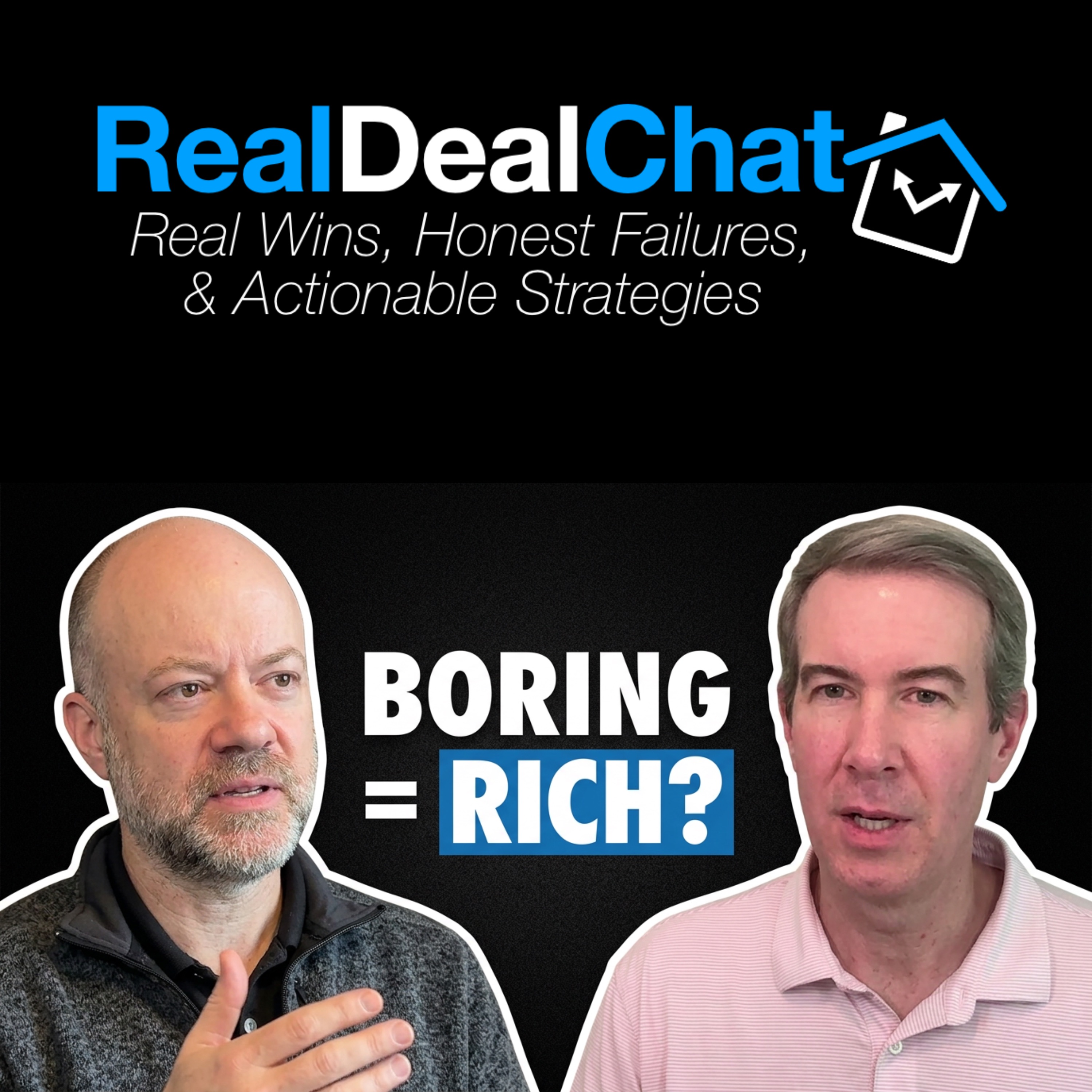
Non-Food Franchising: The Boring Business Playbook for Investors w/ Jon Ostenson
Listen
Show Notes
Most investors overlook franchising. Jon Ostenson shows how boring, unglamorous businesses can become your most reliable cash-flowing asset.
Jon Ostenson is a multi-brand franchisee, former franchisor, and founder of FranBridge Consulting. He's placed several hundred investors into franchise businesses across the country and has spent a decade helping people find opportunities in industries most people never think to look.
In this episode, Jon breaks down why real estate investors are quietly becoming franchise owners, how to evaluate a franchise the same way you'd underwrite any other asset, and why the unglamorous, fragmented industries most people ignore are where the smart money is actually moving right now.
What you'll learn:
- Why 90% of Jon's clients end up in an industry they never had on their radar
- The red flags to watch for in a franchise's leadership team before you sign anything
- How the executive model lets you own a franchise without operating it day to day
- Franchise stacking as a portfolio-building strategy for investors
- Why those top 100 franchise lists are pay-to-play and what to do instead
- How to fund a franchise using SBA loans or a ROBS retirement rollover
Jon's free book, Non-Food Franchising, is available at FranBridgeConsulting.com -- enter your email and they'll send you a download link at no cost.
Work With RealDealCrew
If you’re already closing deals but your intake, follow-up, or visibility feels inconsistent, here are two ways to go deeper:
Take the Deal Intake Assessment
See how resilient your current operation actually is.
→ https://assessment.realdealcrew.com
Book a Fit Call
If you want to explore what a fully system-driven deal flow looks like, let’s talk.
→ https://realdealcrew.com/book
LIKE • SHARE • JOIN • REVIEW
Transcript
what I do oftentimes find is when I use the F word franchise, people think of fast food. And yeah, there's so many other options out there. Nonsexy is the new sexy in business ownership, and John Austinson is living proof. John is a multibrand franchisee, former franchise, and the founder of Fran Bridge Consulting, where he helps investors find franchise opportunities in industry most people never even think to look. In this episode, you'll learn how to evaluate a franchise the same way you'd evaluate any other asset, why fragmented, boring industries are where smart money is moving right now,
and how to find a franchise using tools you probably already know from real estate. If you've ever wondered whether there's a version of business ownership that actually fits an investor's mindset, this one's for you. Check out real deal creative. Brew dot com for more. John Osterson joins me here today and you can learn what his team can help you with. Head over to FranBridgeConsulting.com. Clickable link in the show notes.
We're going to be talking about franchising today, but particularly you have a book, right, John? everybody goes to your page, gives you their email address, you'll even send them your book, Non-Food Franchising. I appreciate that because I understand that restaurants and the like are probably the most difficult thing to get involved in. Is that true? We've got nothing against the food guys.
We need them. We certainly support them. But it's my humble belief there are easier ways to make money. there are a lot of opportunities out there in other industries that may require less operating hours, less hourly employees, less susceptible to consumer whims changing, less capex build out. So again, we need the food guys. But what I do oftentimes find is when I use the F word franchise, people think of fast
food. And yeah, there's so many other options out there. Well, a lot of my audience, actually are going to think in terms of acquisition, cash flow, and scalability. How do you help investors evaluate franchise opportunities the way a smart investor would evaluate an asset? Absolutely. There's a little bit of science, a little bit of art to it.
You know, I personally invest in a variety of different real estate asset classes, as well as other, you know, other private deals outside of real estate. So, no, I very much appreciate the due diligence process. It's what I undergo myself and we expect the same of the franchisors that our clients are working with. So we've designed an exploration process that usually takes close to two months in which they'll get a chance to read over the franchise disclosure document from the franchise or really dig into that.
chance to talk to other franchisees in the system. That's a great point of due diligence, as well as get all the sales and marketing information from the franchisor themselves. My background, I've been a franchisor. I am a multi-brand franchisee. So I'm holding their hand through that process, helping them know how to evaluate different aspects of the deal. Well, what are the biggest red flags that you tell a business they may look?
Maybe it looks good on paper, but in one operate well in the real world. Yeah, for me, and again, this goes to my own investing experience across the board. It starts with the people, right? And, you know, the numbers may look great on paper, but we're looking at not only competitive advantages and uniques about the business, not only the financial models, but also who is that leadership team? You know, is this someone that you want to partner with? What is their background?
Do they have not only industry experience, but also good franchise experience represented on that team? People that have been there, done that support of successful franchisees and their background. So I, again, a little bit of science, a little bit of art. Oftentimes there may be some location specific factors that we weigh as well. What do the demographics look like in their market?
How is the business done in similar type markets? there are industries that try to stay away from you. Things like in-home cleaning or mosquito spray. Things that already have big brands that don't have a lot of unique advantages. Instead, we like the different niches where maybe you're up against a less sophisticated competitor group, right? Maybe more mom and pops, more fragmented space. So that's how we think about it.
Well, could you give us some examples of that? Like what type of businesses are we talking about? Yeah, I'll just, you know, I own a handful of franchises myself. I'll mention two of those as examples. You know, I like businesses, oftentimes they're less sexy. And I find a lot of real estate investors that we work with probably more than I'd say two thirds of our clients invest in real estate as well. There's a lot of synergies, but you know, oftentimes they like these businesses that are
not trendy. Um, you know, they're not going out of style, but, know, I think of two that I own one that is asphalt paving and line striping. So we work with businesses, you every business for the most part out there has a parking lot. You know that's a very less unsophisticated competitive group that we're up against. So we're able to bring a white-collar approach to a blue-collar industry. Another business would be one that provides temporary walls like containment walls around
renovation projects and construction sites. But we're the only franchise that does that, Again, it's very fragmented competition. yeah, but shifting gears, you know, I think of a great driving school that clients of ours are getting involved in, you know, teen driving school, that's required in 35 of the states. And yet there's not another franchise out there that does it. And there's really not that many large players in the space.
It's a fragmented market. So that's how we think about it. You kind of pointed to a couple outliers there that I guess I didn't even realize that there were franchise opportunities for you talking about barriers and construction barriers. And then you had the the line painting and the in the pavement. Like, I don't think there are a lot of people would even consider those franchise opportunities.
There are so many franchises out there that no one has on their bingo card. And it's so much fun for me to get to expose people to this world of franchising. And there are so many niches and probably 90 % of our clients end up going with something that was in an industry never even on their radar. So, you know, we're seeing a lot of smart money right now flowing into things like home and property services, things that AI is not going to replace tomorrow, right? Instead, it can only enhance everything from pool cleaning, the cabinets, to artificial turf installation.
But then we see a lot of interest in other things like health and wellness. Certainly modalities around longevity and such. The senior space is a big one right now. Not just in-home senior care, but other ways that you can play that market where you see that macro grouping of demographics. Like I said, the teen dragon school, and people will always spin on their kids. They'll always spin on their pets. They'll always spin on their health.
You know, at any given time there's a good grouping of B2B services out there as well. I'd say franchising tends to be a little more B2C oriented from a volume of opportunities standpoint, but at any given time you've got a good group of B2B services as well. You mentioned that you're interested in what a lot of people would see as less sexy, but this is actually a pretty trendy topic actually right now. Maybe it's my YouTube viewing, but I get this type of stuff fed to me a lot is investing in boring businesses. Are you seeing kind of an uptick on that information as well or interest?
Absolutely, and we've been on that for a while. I joke that non-sexy is the new sexy when it comes to business ownership. So whether it be port-a-potties or dumpsters or what have you, kind of the trades-oriented type businesses, that's where we see people gravitating. And again, there's just so many niches out there. We had clients that became insurance adjusters. We have others that became freight brokers, others that became consultants around cost mitigation for small and medium-sized businesses.
that again when you hear the F word franchise probably don't come to mind. So, you know, I've kind of seen this more and more in real estate investing, I, know, I have people that come on this show that do mixed use multifamily investing, where they're putting retail on the bottom. And in some times, they will augment the offerings or what's going into those buildings on that main floor by place starting to place franchises that they purchase, and they start to you know, fill gaps where they might not be able to attract somebody locally.
Does that make sense? Yeah, absolutely. We just had a commercial real estate owner in Texas that got into a customer orthotics and footwear business, know, because you had an open space that kind of fit the same dynamics of what they were looking for and a great kind of surrounding customer base. So, no, they will plug and play like that. Others say, hey, I see synergies between business ownership and real estate from a tax standpoint.
Now, obviously with a lot of real estate, you it's offset. get the government incentivized as real estate owners, oftentimes from a passive income, passive loss standpoint, sometimes it's active, but in business ownership, a lot of that can be active losses. So it can be a great compliment. I always say, Jack, if business ownership was easy, everyone would be doing it, right? It does take work. There is a reason why you can make outsized returns.
There's a reason why the government incentivizes it through the tax code. for me personally, and for so many of our clients, within that portfolio of alternative investments, think franchising represents a really strong asset class to complement real estate. You've kind of mentioned this in passing, but I'd be curious as to the process that people go through when talking and engaging with you. Because there's got to be something there. You know, we already touched on the fact that you were bringing up a couple that I
wouldn't even realize that they were franchise opportunities. But there's got to be a good fit there rather like maybe it's the person's background, personality, what have you. Can you just talk about through the process in selecting the proper fit? Yeah, it's just like if you were going to buy a home, you'd use a real estate broker. You'd want someone that knows the area, someone that knows the industry that's got connections that might even be able to find off market deals. Someone that obviously you enjoy spending a little bit of time with.
It's very similar on the franchise side. So similar model. It's entirely free to work with us for our clients. We get a referral fee from the brand, just like a real estate broker would from the seller. And none of that's passed on to our clients. So it's a nice clean model. In my background again, I've run a large franchise system.
I ran Shelf G &E as their president, supporting franchisees all across North America. I then invested in franchise myself on the franchisee side and I started my consulting business about seven years ago and we've placed several hundred clients and very proud of that. I've been on the Inc 5000 a few years in a row. So we've got the relationships, we've got the reputation out there and what I find Jack is we're seeing more interest in franchising than ever before right now. And it's all the more important that you've got someone on your side that can fight for
you because I'm constantly calling in favors to franchise or stuff our relationships with to try to move my clients ahead of other candidates and their pipeline for the same territory. That's the biggest thing that we're up against these days. Hmm. You know, a lot of people that are listening to this show, you know, their primary investment strategy is real estate investing. And you mentioned that this is, you know, you're it's just a lot more work, you know,
like, we're always focused and interested in scalability. Do you have any idea of like what separates a scalable operation and the actual owners removing themselves to a certain extent from that operation. Absolutely. So I'll touch on two things first, about half of those that we work with don't run the franchise day to day. They put a manager in place and I never want to gloss over that or sugar coat it.
It takes having the right operator that you put in place. However, franchising does set up that operator for success if you've got someone that's highly incentivized and motivated because that franchise or can support them from the sideline. So bucks still stops with you. You're the owner. But if you've got a good franchise or on that sideline that they can go to for their daily support.
needs, it takes a lot of the burden off of you. So, franchising does make that executive model, if you will, very doable. Secondly, when you talk about scaling... down the line, you know, I like things that give you optionality and I feel that's a great kind of intrinsic thing with franchising. You've got a built in sea of other franchisees all running the same business day in day out. You're learning from each other.
Well, at some point, some of those are only look to sell their business. And here, you know, the system, you've got the relationships, you get first line of sight into anyone that's selling their location. We have so many client case studies where clients have bought up other franchisees in the system and built a large empire that way. Another option is they can always start their own business. They can always buy another franchise. A lot of our clients will do that's what I call franchise stacking.
And so it gives you optionality as you build that empire. So I always encourage people think about what's right for the next season knowing you may do multiple things before it's all said and done. What's going to provide that good foundation to build off of. So what are the core operating systems you believe every local business owner should have in place if they want to scale beyond one location or one operator? Yeah, you know, in the businesses I've run and I hang out with a lot of business owners across different industries, you we found an operating system like EOS is very helpful,
right? You know, we're all speaking the same language and marching in the same direction. There's constant alignment. So certainly EOS, you know, on the marketing side, you know, we can get pretty granular there. But from a lead generation standpoint, you're having that paid advertising plus organic advertising. think oftentimes people overlook that organic side.
But for a local business, it's all about in the community, sponsoring the Little League baseball team, getting involved in the Chamber of Commerce, that sort of thing. again, one of the things I love about franchising is it gives you a playbook day one. So you're not building a tech stack on your own. You're not guessing at what marketing works. You have an optimized marketing data set day one. They know what works in other markets.
So again, it's just coming in, executing against it. think it... having that built-in system, you can still put your thumb prints on it, you can still build the culture, it's still gonna be your team, you are a local business owner, but you're not having to figure out everything day one from scratch. Yeah, you actually gave a couple people gave people a couple great tips there, because I help a lot of real estate investors with their local SEO. And we call it motivated, motivated seller visibility.
You know, that's the catchphrase in our world. But anyway, you mentioned the Chamber of Commerce. and charitable groups. That's one of those things that I frequently run into that a lot of local real estate investors miss. And those type of of links from those those are considered trusted resources. That really boosts your local search engine optimization. And it's something you should take advantage of.
And it's typically pretty inexpensive. Absolutely, No, I think getting out there and you this day and age Jack it's about building a personal brand it's being known out there in the community as well and You know again, I've been consulting for seven years I've been in franchising for ten years in a lot of circles, you know, whenever they hear the word franchise They associate it with me for better for worse. And so half of our business is referrals, right? And I think for that local business owner again getting involved in the community letting
it be known what you do You're going to get your best clients that way as well. Yeah, I think this one of those things that us introverts cringe on is the fact of having to get out there and doing that networking. But frankly, that's where a lot of the business actually takes place. Yeah, this day new technology. mean, there are different ways to go about that. You know, I think of some clients of ours that did really well with the youth soccer
franchise and they came back two years later and said, hey, we're ready for our next rodeo. We've got a good team in place. And they recently bought a franchise that provides local advertising where they use TV screens in the waiting rooms, you whether it be in a doctor's office or an oil change facility or, know, there's so many places you're in a waiting room type area. But on those, they sell ads on those free installation, but then they ads for local businesses.
So again, for the introverts out there, there may be easier ways to get the word out in the community without having to constantly be shaking hands, kissing babies. Yeah, well, you've already made that mention. I'm absolutely convinced that in this world of AI and everything that's going on, this is actually the way for us to stand out. Everybody kind of dives in, we implement this these these solutions, everything starts to look the same. And for us to really stand out, it's being that human leaning into the human aspect of
things. 100%, 100%. Well, we just touched on AI, but have you started seeing any franchises that kind of lean into it a little bit more than others? Absolutely. And first off on the front end, I mean, we see the drum beat getting louder and louder. Every CEO out there is now publicly getting more and more bold and their head count reduction estimates, right?
I it's in the Wall Street Journal every two or three days. And we're seeing that play out on the ground. have so many reaching out to us saying, Hey, we want businesses that aren't going to be replaced by AI. Like our job is about to be writer. We're being asked to do more or less. Maybe now's the time to make the jump into business ownership. want an understandable cashflow in business.
And no, but all of them have an appreciation for AI and the forward looking franchisees are getting more and more involved using AI, whether it be in the lead generation systems, whether it be more in the training curriculum, whether it be in the truck routing, I think there's a lot of different ways that can be infused in the business. so definitely just like any industry, every industry is trying to figure out how to utilize AI. We talk about franchising as an industry, end of the day, it's several thousand different
companies, And so some are more advanced than others, but I definitely see the embracing of AI in some of these non-technical type fields. Just to remind everybody we are talking to Jon Ostensohn. You can learn more at frayn bridge or Fran bridge, I'm sorry Fran bridge consulting.com that's going to be a clickable link in the show notes take advantage of getting the free book there. And if you found some value in what we're chatting about so far, do us a favor share this with one of your friends.
If you're watching us on YouTube, a like and subscribe goes a long way. So, Jon, I'd I'm actually curious about what we just talked about there. We're seeing, like even in my backyard, we're seeing a significant data center being built. And I'm curious as in my world, I was starting to be curious as to like, what franchises could be used or leveraged in support of such an effort, you know, like you we've already talked about cleaning services and a few other things but maybe there's
something else that I'm missing there but yeah why don't we just start at that that spot Yeah, if we're... I'd say just generally speaking, there are a lot of construction oriented franchises out there, whether it be industrial hoses, whether it be insulation, obviously you've got your paint, roofing, flooring, all of your basics of what it takes, but no, there's so many trades oriented franchises, whether it be electrical, whether it be plumbing, again, things that aren't going out of style and non-sexy is the new sexy. And so a lot of ways for people to get in the game.
You know, what's interesting, Jack, a lot of... people reach out. I've got multiple Harvard MBAs I'm working with right now. They're in this grouping. They say, hey, we'd to buy an existing business. And that could be a great path, but it takes a long time in almost every case to find one. Some have been looking for two or three or four years. They've been under LOI a few times.
But that's one of the things I love about franchising. It allows you to get in the game, allows you to put your thumbprint on the team to build the culture day one with an existing proven business model. And you can always acquire businesses, like I said, down the line, but so many people have been sitting on the sidelines looking for a while. So just thought I'd mentioned that as kind of an anecdote to your question. That is a big trend that we're seeing is entrepreneurship through acquisition, individuals moving over to franchising.
This is kind of one of these questions that I'm going to be really interested in what your thoughts are. Have you read the book, E-Myth? know, the concept is getting into a business that may be a hobby or something you enjoy doing, but in the end, you're not really equipped to actually run it like a business. Are you? Do you see a lot of people come into you because they they enjoy Legos or something and and they jump into that type of into a franchise where they possibly should just hit pause
and make sure that that's the right approach or the right avenue. Yeah, a lot of people when they start their searches online, first off, there's a lot of noise online. And even if you come across a top 100 franchise list, companies are paying to be on that list. It's a PR move. So just a lot of noise out there. But a lot of times they will come to me and say, hey, we reached out to XYZ franchise.
And I have to explain to them, well, if you look behind the curtain, here's why you don't want to be a part of that one. Franchise is just like every industry. You've got great players and you've got some that don't provide great support. They're not ones you'd want to... partner with. I Jack is everyone's decision making criteria, how they prioritize different characteristics in the business is a little bit different.
I've got some that say, hey, we want to be passionate about the business. I see that a lot of times in like health and wellness, right? It's like, I love the local gym. I'd love to get a recovery modality type longevity franchise to partner with that. Others say, hey, for me, it's all about the financials. I don't care what the business is. It's all about the bottom line. What I find is most people are somewhere in between those two extremes.
I mean, the finances have to check the box. There's gotta be some level of interest. But most people come to us and say, hey, we're pretty open-minded. We're a blank slate. And I've got a client that's signing this week in Dallas for four territories of a dog cleanup franchise. So this business, it's a recurring revenue business in high-end neighborhoods. come in, they scoop the the dogs stuff.
And so... He never thought he'd be in that. He's a multi-million dollar corporate executive, but he's like, that is a high margin business and I see the need for that in my community and let's go big, let's go do this. So some individuals are more open-minded than others, but most come in pretty open. That's, that's interesting. Again, there's another franchise opportunity that I don't think anybody would even think is is available.
One of the things that strikes me is that real estate investors that I work with there, it's it's pretty common for people not to take a take a moment, build out their SOPs and and their operations to the point of of eventually removing themselves and eventually document a few things. But what what you're what franchising actually really does is provide those that significant amount of information and tent poles right up front. I just think that it's a lesson that we should probably take from the franchise world that in order to run a successful business, some of this information
And some of this stuff needs to be taken care of and laid out and documented. You're exactly right and that's feedback I give to business centers all the time. I'm a member of EO, Entrepreneurs' Organization, and they always ask me for feedback on how to improve their own current businesses. I tell them, hey, pretend like you're going to franchise it. Maybe you actually did. Maybe someone should be franchised. But going through the process of thinking through how would I explain things and train an
outside individual that was going to run my business and open up in another market is a very healthy exercise because especially now AI can help you with a lot of this, thinking through the standard operating procedures to your perspective, how do you onboard team members? How do you go after, you national marketing or, you know, there's so many different nuances that you can pull into that. I think if you're thinking about your business as if you were going to franchise it, it
gets you thinking in a healthy way and looking at your business with different eyes. You've already talked a little bit about the delegation and hiring an operations manager so you can step away a little bit. Are there any other tips or tricks that you would advise people to, like low-hanging fruit, the things that they should maybe even consider implementing in their business today that could impact their operations? Yeah, some of the things I've learned over the years just when it comes to the personnel, for instance, hiring a key employee, you know, we're always looking to hire key key
general managers or operators. You know, post that job in several different areas, different titles, you never know what someone's searching for out there. And when you do find the right individual, you know, titles are free. You don't want to grossly over title someone. But what I found is if you bump them up in that title, Oftentimes they'll rise to the occasion of what that responsibility is. And titles matter to a lot of folks, especially the millennials these days.
so thinking through the title strategy is important. Also, when it comes time to deliver a compensation package, instead of just handing it to them saying, here's what it is, take it or leave it. What I like to do is give three different options and you have different levels of variable compensation within each of those options. Obviously as the owner, you hope that someone's going to choose the one with the most variable comp. They give some of highest upside and it's
incentivizes them the most. But end of the day, you never know what someone's background is, where they're coming from, what their current financial situation is. And so if you give them the three different options, what I find is when they pick one, they take ownership of that all the more because you gave them the choice. So those are just a couple of little hacks that come to mind. Sure. Well, this has been a great and interesting conversation, John, and you know, there's a
number of questions that we probably should still try to hit on. I wanted to give you the floor for a second. Is there anything else we should be hitting on before we start transitioning and closing out this episode? A common question I get asked is how do you fund the business? What does that look like? And just for some context there, if you look at the franchise fee and your startup cost and several months of working capital, all on investment, if it's more of a retail style
business, you're probably in a 400,000-ish ballpark give or take. If it's more of a service-based business, which a lot of these are where you don't have a physical location, oftentimes you're more in the 150,000, 200,000, all in investment range. And SBA loans tend to be incredibly common, especially amongst real estate investors. Probably two thirds of them will use an SBA loan and leverage up that way. But you can also roll over an old retirement plan through what's called the Rob's program
and purchase the business that way. I just thought I'd mention that because that is a question that we get a lot of times. Yeah, I appreciate you bringing that up. It just completely bypassed me. But when it comes to real estate, I mean, that's half of my episodes is all about funding. So I should have thought about that for this as well. Well, well, john, we're going to transition into the rapid fire and close out this episode.
But before we do, I want to remind everybody again, we are talking to john Ostetson, you can learn more at Fran bridge consulting.com click the link in the show notes get it to get that book that's It's an awesome opportunity for you to take advantage of that. I still find it silly, John, that we can just acquire a book, in your case, free for an email address. And the amount of information that's available to us for such a low cost is ridiculous to me.
And to clarify, what we'll do is we'll send you a link where you can download the book, either PDF, know, Kindle version, audio version. If you'd rather purchase a physical copy, you know, they're on Amazon everywhere else. We've sold thousands of copies and all the proceeds go to Hope International, which is a great nonprofit that we support. So just want to give that plug. I appreciate it. Well, if you're ready, john, we're gonna drive and dive into the rapid fire and close out
this episode. What lie do entrepreneurs often tell themselves? think that I'll use the case of the franchise. I think that if you were to buy into a franchise that everything is turnkey and works by itself, you don't have to put in the effort. End of the day, I tell people if business ownership is easy, everyone would be doing it. There's a reason why you can make outsize returns. If you could go back in time and give your younger self a piece of advice, what would it
be? Don't put so much pressure on yourself. I think careers have a long and windy road. I actually gave a talk to our old fraternity chapter this past weekend and that was my message to them was, I never thought that two years out of college I'd be in India. Never thought that later I'd be working for a multinational company that sold baby clothes. Never thought I'd be in franchising, but I keep saying yes, stay active, and doors will
open. Do you have a book recommendation or what are you reading right now? Yeah, well certainly outside of my book, the compound effect by Darren Hardy has been a great resource. It's not rocket science, but end of the day, it's a constant reminder of making small incremental progress across all five domains of life every day, and they compound over time. And finally, what single process or tool have you implemented that has had the biggest
time-saving impact? think there have been different degrees of automation within our business. I've got an assistant over in the Philippines and just partnering with him, questioning everything that we do on the backend and how we can expedite things. So I would say to answer your question specifically, utilizing a virtual assistant and handing off as much as I can to them, even if it's 80 % of how I would do it, it's worth the investment. One more time, is John Ostenson.
You can find more at FranBridgeConsulting.com. Clickable links in the show notes. But really appreciate your time. This was great. And I hope you'll consider coming back again sometime real soon. Enjoyed it. Thanks for having me, Jack.
Work With RealDealCrew
If you're closing deals but your intake, follow-up, or visibility feels inconsistent — start here.