
Capital Gains Tax Strategies Without a 1031 Exchange w/ Mark Myers
Listen
Show Notes
Mark Myers reveals how real estate investors can legally slash capital gains without a 1031 exchange.
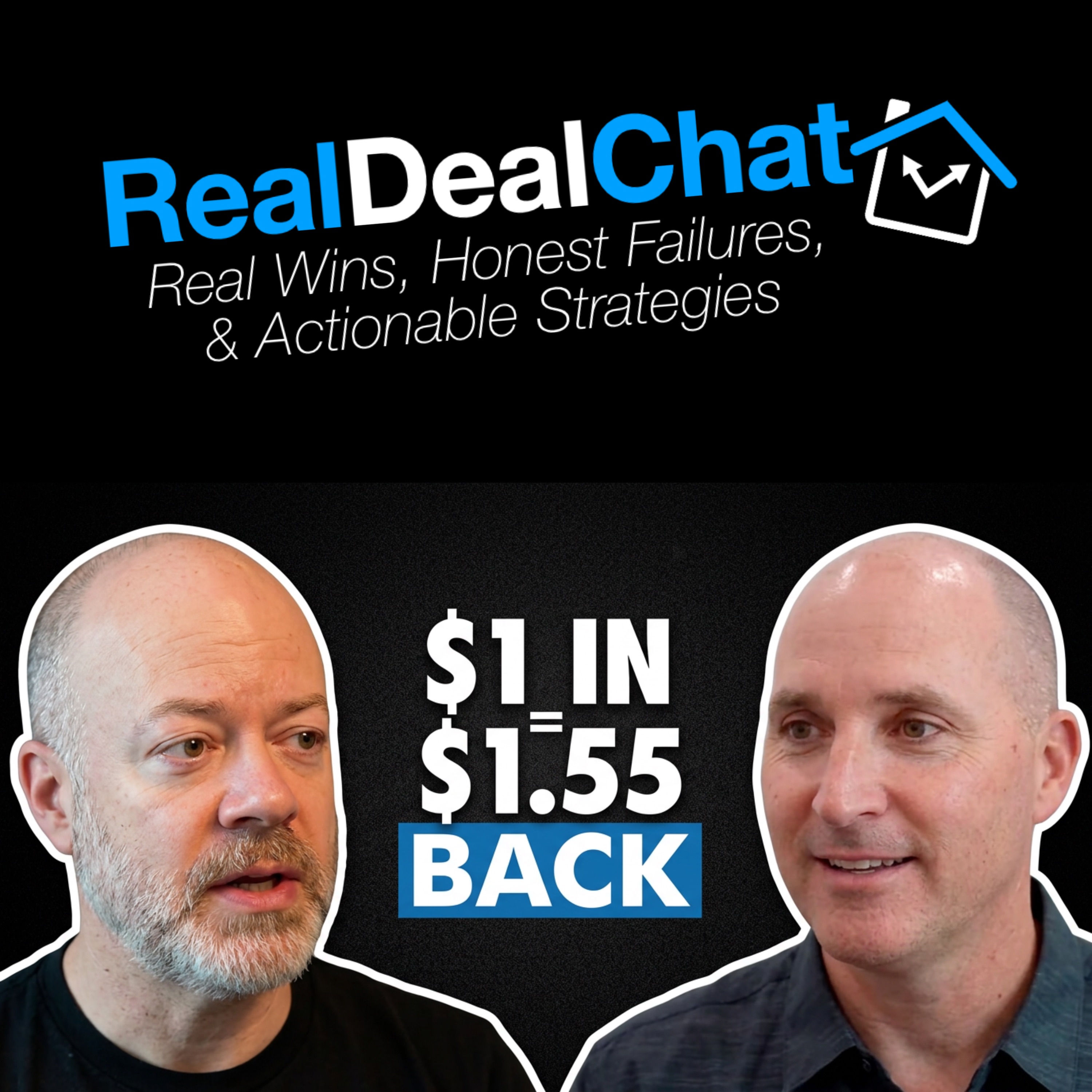
Mark Myers, founder of TaxWise Partners, joins Jack to break down the tax strategies most CPAs never have time to explore. Mark's team acts as a bridge between investors and their existing CPA, vetting advanced strategies through tax attorneys and accounting partners before recommending them to clients. In this conversation, Mark and Jack cover a strategic partnership alternative to the 1031 exchange, why donating assets instead of cash can produce a bigger deduction than the gift actually costs, how an S-corp salary structure can save 15.3% on employment tax, and why buying solar panels on a commercial property can save $1.25 to $1.55 in taxes for every dollar invested. If you are a real estate investor, house flipper, or self employed business owner who wants to stop overpaying the IRS, this episode is built for you.
Key topics:
- Legally avoiding capital gains tax without a 1031 exchange
- Pre-sale tax planning for house flippers
- Donating assets instead of cash for a larger deduction
- The S-corp $60,000 salary secret
- Solar tax credits versus buying a rental property
Guest bio:
Mark Myers is the founder of TaxWise Partners, where his team works alongside CPAs and financial advisors to find advanced, compliance reviewed tax strategies for real estate investors and business owners.
Links:
🔗 TaxWisePartners.com for a free 20 minute consultation
🔗 Full transcript and episode page: [link to episode page]
Work With RealDealCrew
If you’re already closing deals but your intake, follow-up, or visibility feels inconsistent, here are two ways to go deeper:
Take the Deal Intake Assessment
See how resilient your current operation actually is.
→ https://assessment.realdealcrew.com
Book a Fit Call
If you want to explore what a fully system-driven deal flow looks like, let’s talk.
→ https://realdealcrew.com/book
LIKE • SHARE • JOIN • REVIEW
Transcript
what if putting in a dollar could save you more than a dollar? That's not a typo. My guest today shows real estate investors how to save up to a dollar fifty-five in taxes for every single dollar they put into the right structure. Mark Myers is the founder of Tax Wise Partners. Where his team digs through thousands of pages of tax code to find the strategies most CPAs never have time to chase down. In this episode, you'll learn how to legally slash capital gains without a 1031 exchange,
How donating assets instead of cash can turn a 20 cent cost into a 50 cent tax savings, and why buying solar panels might beat buying your next single family rental. Stick around and if you want systems to run your investing business better, check out RealDealCrew.com. Let's get started. Mark Myers joins me here today. You can learn what his team can help you with. Taxwisepartners.com.
And I guess your name says it all, right, Mark? You talk and deal with taxes, especially on the real estate side on a regular and daily basis. Absolutely. Consider us your TaxWise partner and we walk alongside your CPA and even your investment advisor because we do not do those things. We do not prep taxes, we do not file taxes, we do not do bookkeeping, we don't tell you how to invest your money, we just show you how to reduce your tax following the tax code.
Well, this is one of those things that I'd like your take on it, because actually, what you're really doing is providing direction and advice when it comes to tax, people's taxes. It actually seems like my experience, people are almost, when I've tried to get tax professionals to give me some direction and advice, they're almost a bit repulsed by it. Like I can't... They this is something that they're not comfortable doing. But you're kind of leaning into this.
Like what has what led you to that? I really feel it was the need, the need in the marketplace. mean, nine out of 10 tax professionals, know, those that will prep your taxes and file your returns for you, are really overwhelmed with just the logistics of tracking, recording, properly filing, compliance. They don't have the time. They don't have the bandwidth, and a lot of them don't really have the desire to do forward-facing planning.
So that leaves you know one out of every 10 CPAs really wants to dig into that space but we want to make it super easy. So we can generally help you know the nine out of ten that aren't already proactively looking to do this. We can help them. basically bolt this onto their offering without a lot of heavy lifting on their part. Now all of a sudden you've got a lot of advice coming through that channel that you didn't have before.
Yeah, it's one of those things that, you know, I've mentioned in the past on regarding different industries. It's sometimes hard to find a company to partner with, and your interests are aligned. Can you talk a little bit about how you make sure that you're you're in alignment with the real estate investors you're working with? Absolutely. We know first and foremost, depending on our audience, and if real estate investors, that's one of our audiences, we want to make sure that you know that we're not looking to
have you redistribute your capital. to things that are non-real estate, particularly if you love real estate and you want to accumulate more real, a larger real estate portfolio. What we want to share with you is how we can have you redirect your tax liability to things that are going to give you more tax savings than the cost to redirect. and that leaves more money in your bottom line or in your account. And if you have more money in your account, that gives you more money to purchase real estate with.
So we're really unlocking real estate purchase potential by reducing your tax. Yeah, when your team reached out to me, one of the line items that really caught my eye, and I think you're kind leading into this, is how real estate investors legally slash capital gains without 1031 exchanges. And I think that's going to be interesting for everybody. Can you talk a little bit to that? Absolutely. So when it comes to selling an appreciated asset, particularly real estate, everyone here
on this podcast understands that a 1031 is a way to kick the can down the road and not have to deal with that long-term capital gain or possibly short-term capital gain right now. So the challenge with that, as you know, is you have to identify a like property in 45 days. You've got to close on 180. lot of times 1031s don't make it to the finish line because of the challenges with the replacement property.
And also sometimes people just want a little bit more time. They want a little bit more time to find that new piece of real estate or maybe they don't want to go 100 % of their profit back into real estate. So there are alternatives to 1031 exchanges. One of the most simple alternatives that gives your client the real estate investor, the most latitude and the most flexibility with the proceeds of their sale is actually joining a strategic partnership. Well, why would they join a strategic partnership and how could that help them with their
taxes? Well, if that partnership is focused on profit production, but that partnership can also distribute to them a negative K1 to offset the positive income they have from their sale and that partnership cost is substantially lower than the taxes they would have paid if they didn't have the long-term capital gain offset. Well, now we're onto something, right? So that's one of the, there's a lot of different ways to reduce tax on the sale of an
appreciated asset. But one of the ways that we do this consistently over and over again is help. Our clients enter into a partnership, their capital contribution into that partnership will help them produce income. They will make money on that money, but that partnership will distribute to them a negative K-1. That's one of the benefits. They disproportionately allocate a loss to you, the partner, and you can use that loss
against your long-term capital gain real estate sale. very nicely handled and of course when you're exiting that partnership in the future you will receive a positive K1 for the same amount but just like a 1031 you pay the price somewhere down the road but that could be 10, 15, 20, 30 years and Hey, if that interest in that partnership is properly handled in your estate, well guess what you get? Just like with real estate, a step up in basis. So the estate would not have to deal with the taxes if there's a step up in basis just
like real estate. So it's an alternative to a 1031 that's very flexible. Do you do you have like some guidance for people then in order to find these type of funds or is that just that that again outside of your scope? No we do, we have relationships. Our work Jack is we are the Sherpas so to speak. So we're the brokers slash Sherpas. We go out there and we look for and we vet.
the dozens and dozens and dozens of strategies. you know, we, when we go through this, we have our tax attorneys review them. They have, we have our accounting partners review them. So compliance reviewed, tax law reviewed. We throw out all the things that will not work. And we're left with what we feel is the most conservative application for tax mitigation. And by the time we're presenting it to you, it's already been vetted by a number of different professionals.
And we already have resources in place that can execute. not only are we going to give the ideas, we're going to say here are groups that we have vetted that can execute this strategy for you. And there's a fee of course, but that fee always is significantly less than the tax efficiency that is produced. Well, there's a number of people that are listening to this that are house flippers for example couldn't could we speak to that audience for a moment?
Because one of the other things that caught my eye was the pre-sale tax planning the million-dollar mistake most business owners make is That associated with possible strategies associated with with house flippers Absolutely. I house flippers, I would say, for the most part, fall into the short-term capital gains bracket, depending on how fast they can turn that home around. Short-term capital gain and long-term capital gain can be offset with this partnership, participation of this partnership, or we can actually plan structures that effectively
offset the tax on that sale. So for example, if all of the sales, all of the assets that are being sold are being sold by an entity that is controlled by the real estate investor but not owned and an intermediary handles the transactions, meaning that the real estate investor never actually touches that money and the assignment of income doesn't come to them legally. Well now the tax burden is shifted over to this specialized entity.
Well if the specialized entity can structure the sales such that there's no initial profit, well then there's no tax to that structure. So now you just avoided legally a 20 or 23.8 or 23.8 plus state tax, right, or even higher if it's short-term capital gains, and now you can reinvest all the dollars in that entity structure because you do have control over it and now you're earning money on money you would have never had right because all that long-term or short-term capital gains tax would have been gone now when you extract money out of that trust
or that entity usually a trust, there is a tax liability. So you want to manage the way that you extract money, but you're only extracting dollars for personal living needs, right? Obviously everything that's in there, you're going to want to continue to keep growing for you and reinvesting and creating earnings. So it's really worth saying, this is a very... efficient structure in helping to manage those churning gains and then you can strategically reduce, remove money from those structures over time to give yourself a more
beneficial tax output. You've made the bold claim that over 90 % of successful businesses still overpay their taxes. What's what's missing there? Well, that's where the well-meaning tax professional that says, have you got all your expenses? Is there any more capital assets that you need to buy to make sure that you can run your business?
Because we can Section 179 them. When you've gotten through that conversation and there's nothing more that can be done and they're saying, well, this is your tax bill, that's when we step in because again, nine out of 10 CPAs are going to go to that level. and they're not gonna have these additional layers of benefit. And even if they did, or they knew of them, a lot of times the only groups that can efficiently implement these things, Jack, are groups that also do tax preparation and planning and bookkeeping.
So as a CPA or a small business owner, You would never refer your highest net worth clients to another group that does tax playing that also does tax prep and filing and accounting and bookkeeping. So that's where we step in. We actually don't do any of those things. We walk alongside these CPAs and give them these additional layers of value for their clients. And that's the reason.
It's just not enough time of the day for the tax professional to really explore 75,000 pages of tax code and determine which strategies are the most applicable and who actually can execute them efficiently. Well, we're almost halfway through the conversation. And and I know that it's usually late in the in most podcasts. But a lot of these strategies mark are, you know, they sound on it on the surface fairly complex.
And the rabbit holes that you've obviously gone down have consumed many, many cycles of your time. May I ask like, what led you to this type of profession? Jack, great question. know, my background is exercise physiology and sports management. I got my undergraduate degree at the University of Florida in exercise physiology. I got my master's in sports management. I moved to New York City in my early 20s to manage really high-end health clubs and then
they relocated me out to Los Angeles to open a number of health clubs out there and then in that process my first 10 to 12 years of career, really understood and learned how to run someone else's business. And those businesses were really generating profit and I was bonused on EBITDA margins. So was how well was I managing driving revenue, how well was I managing expenses, what was our EBITDA, and I would get bonused on that. And I realized over time, wow, I'm getting efficient and helping and running a business, but I'm not running my own business.
So I was capped financially and was working really hard. It's really an industry that's very, very challenging time-wise. It's 24-7. So I left that industry and became a consultant for business owners because I knew how to speak business owner language. I went into insurance planning because that's kind of the layer, know, key man planning, know, buy-sell agreements, etc.
And I realized there was a lot more to tax efficiency than just insurance work. So about a decade ago, I've dedicated all my time to saying, hey, I'm not really focused much on insurance anymore. I don't really do any insurance at all anymore. But I do focus on all the different ways to reduce tax because of the incentives that are inside the tax code for us to take advantage of that we may not have time to determine that they're there. Or even if we know that they were there, we just don't know how to properly
execute them. So that's where I've been the last 10 years and my journey has gone from running other people's business to consulting work in the insurance space to consulting work in the very specific advanced tax strategy space. Yeah, this is kind of unique because it wasn't too long ago where I read or heard, you know, the the adage that in many, many small businesses, the way you way you earn money is to not spend it, or you try to do what you can to keep it. And I would imagine in many in some of the people that you're talking to, especially house
flippers. one of their biggest expenses has to be taxes and the lack of preparation for 100 % and this is where we like to say treat your tax burden like a profit center. Because a lot of times you know the goal is how can I drive more revenue? How can I find that next deal? How can I get turn this quickly get the right interest on my hard hard money lending etc. Well if you know that you got a hole in your bucket that's anywhere between you know 23.8 % and 37 % excuse me
50 % if there's short-term capital gain, well that's an area that's worthy of focus, right? If you can reduce that 23.8 to 50 % hole in your bucket by some initial planning, you know, you can be, you can get that much further ahead very quickly. And if this sounds a bit overwhelming, you know, that I think the government has created that by design, and it just becomes somebody you do need this level of expertise. Mark is offering everybody a free 20 Is it a 20 minute advisory call that they can take advantage of?
So head over to TaxWisePartners.com. Take advantage of that. If you found some value in what we're chatting about so far, do us a favor, share this with one of your investor friends. If you're watching us on YouTube, give us a like and subscribe. So Mark, I kind of prepped you for this piece of it is that I'd like to give everybody, whether they're first time investors to the seasoned investor, what are some of those obvious low hanging fruit?
that people can maybe implement today that could actually make a big or a significant difference for prep for the next tax season. Jack, think that the lowest hanging fruit we have is something that's kind of counterintuitive. All of the listeners of this podcast, and of course any high income earner, should think about being charitable every single year. So this is where it becomes kind non-intuitive. Well, when somebody says, well charitable, I'm already charitable, or...
be charitable but last time I checked every time I give away a dollar I'm saving 23 23 cents to 50 cents depending on my tax bracket. where's, show me the math. How is that profitable for me? I know that if I give a dollar to my favorite charity and I happen to be in California and I'm looking at short term capital gains tax, well I'm saving 50 cents so I got to give my favorite charity a dollar. It only cost me 50 cents to give them a dollar but when I looked at my net worth
statement, it says 50 cent less. You know, I'm losing 50 cents on that dollar so how are you telling me that low hanging fruit is I should be charitable every single year, well, don't give away cash. Give away assets. So interesting, when you give away an asset, if you follow the rules, you get to take the appraised value, the current market value for that donation of the asset. What we do as a brokerage and a consulting group is we help you find assets that the
owners are willing to sell at a substantial discount to the current appraised value. Why? Because their cost basis is very low and they're looking for capital. So they're willing to sell you this asset at a substantial discount to what it's worth on the market because they're looking to bring some capital in their pocket to do more business. They know that you're going to donate it because this is the way the structure are set up.
Technically you could take it out and do whatever you want to with that asset but most of our clients determine that it's much more effective for them to just donate because, forgive an example, if we can give them a $1 deduction for 20 cents and they're in a 30 to 40 to 50 % tax bracket, well that $1 deduction saves them 30 cents, 40 cents, 50 cents, and we sold them that deduction for 20 cents. Now we can do the math. Now you can basically get a 30 or 40 or 50 cent tax savings and it only cost you 20 cents to get it.
We like that math, and that gives you more money to purchase real estate. Yeah, that's an interesting strategy. I don't think a lot of people might have even considered that. You know what, a lot of the people that are listening to this show are also self employed. You also have strategies around retirement and how the IRS can fund your retirement. Can you talk a little bit about that strategy? I'm sure people are would be interested. Yes, absolutely.
think really the way that we position this, Jack, is because most of our business, most of our strategic partners are registered investment advisors, financial planners. Obviously we have our CPAs and our enrolled agents. This is really for them, for the RIAs, because we don't manage money. But what we do is show you how to spend a dollar to save more than a dollar in tax in the very same year. So whatever that delta is, you can look at it as a tax-free retirement, right? Because you essentially receive the benefit from the federal government or the state
government, right, in the form of tax reduction. So there's your federally... your retirement strategy. in the dollars that you receive as arbitrage. Now, what do you do with those dollars? Well, that's completely up to you. Whether it's more real estate, whether it's stocks and bonds, some people really like to put it into cash value life insurance.
Why cash value life insurance? Because once you fund it into that, it will grow tax-deferred or tax-free, and you can borrow against it tax-free. So now you have essentially received this tax savings by being strategic in your planning, taking the tax savings that you would never had, putting it into an investment vehicle that will never pay tax again. So those are just the different ways that you can approach it.
We leave that planning up to our strategic partners, which are financial advisors. But of course, if someone comes to us without a financial advisor, we have many, many, that are fantastic at what they do that we can refer the listeners of the podcast today to. A lot of people that are doing this, they're always in the process of, you know, whether they've picked the right type of entity, whether it's an LLC and S corp and the like, you have something about how S corp election save 15 % on everything. And there's a 60,000 salary secret.
Could you talk a little bit about what you meant by that? Yes, so if you think about S corporations, one of the attractive benefits in utilizing a sub-chapter selection on your LLC or just launching an S corporation is that you can pay yourself a reasonable salary. Now, $60,000 may not be a reasonable salary, but Due due diligence, there's an opportunity for online to find what the average salary for the type of work that's being done in that entity. And if that salary is less than $175,000, now you've got some nice employment tax savings.
Why? Because up to $170,000, there is an employment tax that applies to every dollar earned, which is about 15.3%. So if you are in an S corp and you can actually validate or justify a salary of less than 170, say it's 100,000. Well now there's $70,000 that you don't have to pay that employment tax on because you're only... you only are required to pay employment tax in an S-Corp on your salary.
Anything that's distributed above and beyond salary is not subject to employment tax. So that can be a nice 15.3 % savings for every dollar between your salary and $170,000. And by the way, there is this really nice benefit that's been around since the 60s that was created around this little green jacket event in Augusta. And if you're not renting your home your S-Corp up to 14 days per year tax-free that's something you should look at as well. Yeah, see, there's all of these these strategies that can really add up pretty quickly, isn't there?
Well, we're going to jump into the rapid fire and start to close out this episode. But I was hoping we could give everybody maybe one more strategy that could really move the needle like on a tax reduction side of things. Absolutely, Jack. I would say this is another counterintuitive recommendation, but instead of buying the single-family residence as an investment and a tax offset, buy solar panels on commercial properties instead. Why?
Because every dollar that you put into your solar business, which we can make totally turnkey, you're selling energy to a commercial operator that needs the energy for less than the utility company charges them for energy. So you're selling a commodity at a discount and that's creating cash flow for you. But think about it this way, every dollar you put in your solar business, if it's structured correctly, you can save anywhere between a dollar and 25 and a dollar and 55 cents in taxes. Plus you get that stream of cash flow coming in come to you.
So I'm not saying not to buy the single family residence. I'm saying buy the solar project first because that's going to give you positive cash flow just like the single family residence. But it's also going to give you tax credit and a whole bunch of depreciation right out of the gate. So now that dollar and 50 cents you would have sent to the government, you only put a dollar in your solar business to not send a dollar and 50 cents to the government. That gives you 50 cents to more than you would ever had to go buy a single family
residence. You Yeah, you well and especially what we know what's what's happening right now we we have kind of a shortage when it comes to energy. And with all of these data centers, because of AI and everything coming online, it's just going to get more and more needed. Absolutely and solar is free and as the batteries get better and better, it'll be lower and lower costs.
because the federal government provides an incentive for screen energy, even the one big beautiful bill, we can still have five more years of tax credit coming from solar projects. We have a way to do this through safe harboring. So we have the ability to put people into the solar business for the next four or five years and continue to get that beautiful tax credit that the Inflation Reduction Act offered. and the one big beautiful bill took away.
We have sustained that and made it available to our clients for the next five years. Even if they don't start their solar business until this year or next year or the following year, we have allocated safe harbor projects for them to buy into and still receive the tax credit. So this is probably something that a lot of people haven't considered because if you have a multifamily commercial property, you know, there's a lot of rooftop spaces that are just really being underutilized right now. And it could actually become a profit center, or in your case, a significant tax benefit.
Absolutely, Jack. And here's the thing, whether or not you're the owner of that multifamily wants to come out of pocket to purchase the solar or not, it's still beneficial for them. They can actually allow a third party to own those solar panels. It didn't cost them a dime, but it increases their net operating income because they've just lowered the utility bill for all of their other tenants. And that's an improvement to the structure. however they decide to do it, whether they're paying for it and receiving their own tax
benefits or someone else's paying for it and they're just increasing that operating income, it's completely up to them. So there doesn't have to be this huge liquidity call which a lot of people know, hey well solar is great but it's expensive. Well only if you structure it, I mean it's not expensive if you structure it the right way. Well, Mark, this is fantastic.
I really appreciate you giving us the time before we jump into the rapid fire. Is there anything else we should have tried to hit on here today? No, these questions have been fantastic, Jack. I just want to make sure that, you know, obviously everyone knows how to get in touch with us, which is to go to our site and book a complimentary appointment. Within 15 or 20 minutes, we can tell you what tax efficiencies are available to you, and that's at no cost. And you can find that information at TaxWisePartners.com.
That's going to be a clickable link in the show notes. But if you're ready, Mark, we'll jump into the rapid fire and close out this episode. Let's do it. What lie do real estate investors often tell themselves? that they have, see, let's, I think that, let me think about that question for a second. I'm not stumped, I'm just trying to think of the right response. So a lie that real estate investors tell themselves. Let's put it this way, that there's not enough inventory available at a discount.
If you could go back in time and give your younger self one piece of advice, what would it be? would tell myself to take calculated risks earlier in life. Do you have a book recommendation or what are you reading right now? I really like this book. It is Pillars of Wealth by Stan Bernstein. It's a very good book. It's very good basics.
Get the basics right and you can never, I can never not mention the Bible. And then finally, what single process or tool have you implemented that has had the biggest time-saving impact? We have actually generated an education tool that utilizes an AI chatbot. A lot of our strategies obviously have a substantial amount of legalese and tax code that apply to it. So when our clients utilize this educational resource, they have access to Max. Max Savings is our AI chat bot's name.
So Max Savings can answer questions for them and rifle through hundreds and hundreds of pages of due diligence and give them the answer and share with them exactly where they were found in that stack of papers and it doesn't go online to try to figure out the answer from OpenAI. It's only searching the data that we provide. So that's been a real blessing for us and our clients. And then I have to ask how long did your team take to come up with the name max savings? Can you ask that question one more time?
I said, how long did your team, what, how much time did your team spend on coming up with the name Max Savings? You know, it was actually an accident. I said to our technology officer, I said, we need to come up with a name for this client. I mean, maybe we just just call him Max. I wasn't even thinking anything about it. Like just Max sounds like a cool name. And he said, yeah, we'll call him Max Savings.
So literally within two minutes by accident, we found the name. Well, it's clever, right? It's funny how some of those things just naturally happen. Well, Matt, Mark, I really appreciate your time one more time. Tax wise partners.com clickable link in the show notes. But really appreciate your time and hope you'll come back again real soon. Thanks for having me. I certainly will, Jack.
Thank you.
Work With RealDealCrew
If you're closing deals but your intake, follow-up, or visibility feels inconsistent — start here.