
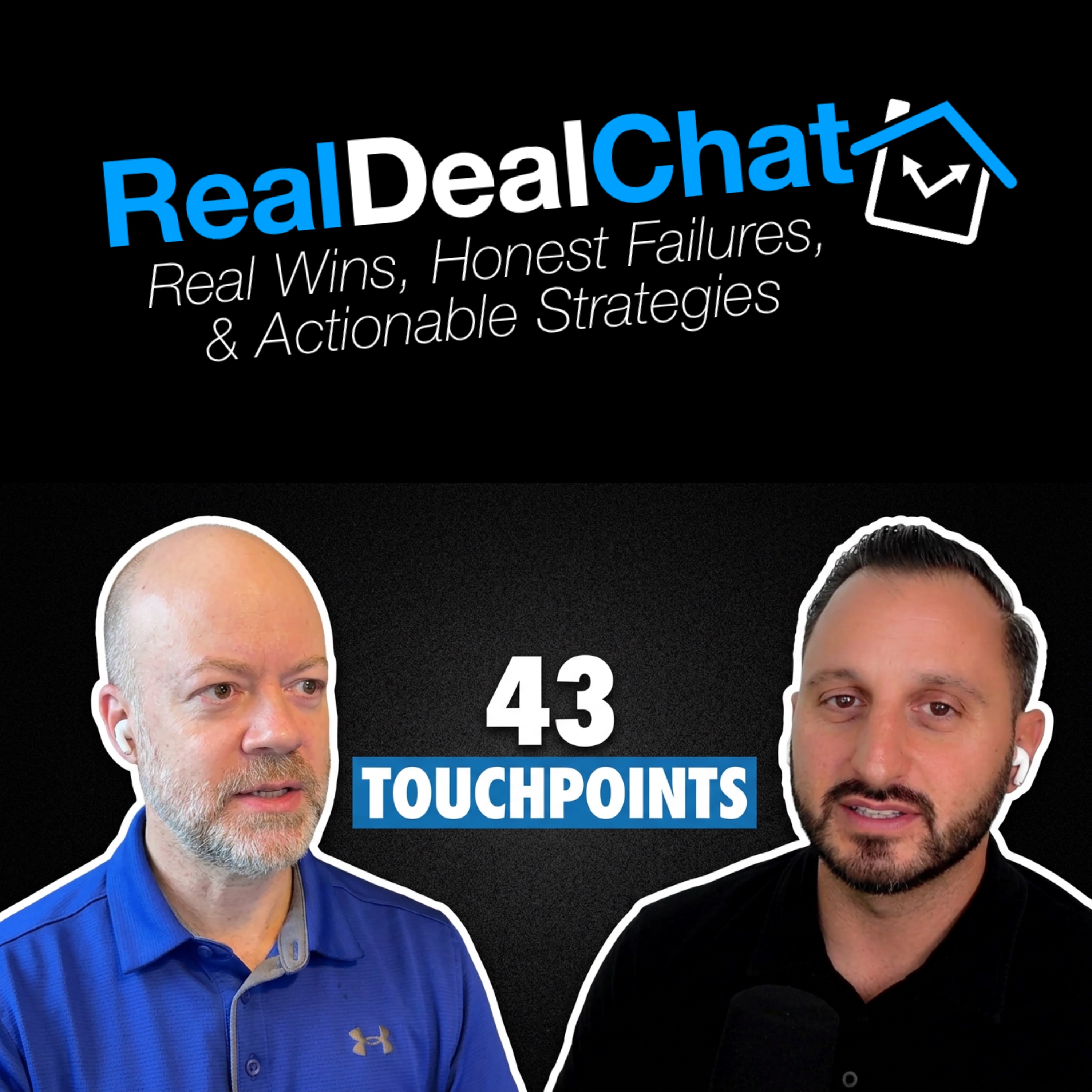
43 Touchpoints to Close an Investor w/ Jason Fishman
Listen
Show Notes
It can take up to 43 touchpoints before an investor actually wires money into your deal.
Jason Fishman runs Digital Niche Agency and serves as vice president of the Crowdfunding Professional Association. He joins Jack to break down how real estate sponsors legally market Reg D, Reg CF, and Reg A+ raises to reach accredited and retail investors, and why most capital doesn't close on the first touch. They cover why Meta consistently outperforms LinkedIn for ad conversion while LinkedIn wins for direct outreach, how third party validation and social proof move skeptical investors, and why ranking on AI tools like ChatGPT and Claude now matters as much as ranking on Google. Jason also lays out the difference between AI use that helps and "AI slop" that hurts response rates, and walks through exactly what each SEC exemption allows you to say and do.
Key topics:
- Why it takes 7 to 43+ touchpoints before an investor actually converts
- Meta vs LinkedIn for real estate capital raise marketing
- Building social proof and third party validation investors trust
- GEO: getting found by ChatGPT and Claude, not just Google
- Reg D, Reg CF, and Reg A+, what each one actually allows
Guest bio:
Jason Fishman is the founder of Digital Niche Agency and vice president of the Crowdfunding Professional Association, where he works directly with the SEC and Congress on capital formation exemptions.
Links:
🔗 Learn more from Jason: https://digitalnicheagency.com
🔗 Build systems for your investing business: https://realdealcrew.com
#RealEstateInvesting #CapitalRaising #RegulationD #RegulationCF #RegulationAPlus #RealEstateSyndication #DigitalMarketing #InvestorRelations #RealDealChat #PropTech #AccreditedInvestors #REIT #MarketingStrategy
Work With RealDealCrew
If you’re already closing deals but your intake, follow-up, or visibility feels inconsistent, here are two ways to go deeper:
Take the Deal Intake Assessment
See how resilient your current operation actually is.
→ https://assessment.realdealcrew.com
Book a Fit Call
If you want to explore what a fully system-driven deal flow looks like, let’s talk.
→ https://realdealcrew.com/book
LIKE • SHARE • JOIN • REVIEW
Transcript
If you're able to show hundreds of investors, thousands of investors, on the regulation A plus side, I have a client with over 59,000 investors. One sponsor on this episode has over fifty-nine thousand investors
in a single raise, and that did not happen by accident. In this episode, you'll learn why Meta consistently outperforms LinkedIn for converting capital raise ads, the real number of touch points it takes before someone actually wires money into a deal, and how you get the offerings
found on Google and by AI tools like ChatGPT and Claude before your competitors figure it out. Jason Fishman runs Digital Niche Agency and serves as the vice president of the Crowdfunding Professional Association.
He's built marketing campaigns across Reg D, Reg C F, and Reg A plus. Raises and knows exactly where the legal lines sit. Stick around because we get into what actually allowed and what isn't. Let's get started. We have Jason Fishman on the line and you
can find how his team can help you by heading over to digitalnicheagency.com. Of course, it's going to be a clickable link in the show notes. Really appreciate your time here, Jason. We're going to be talking about digital marketing and investor outreach,
which is an important aspect. And there's a lot of regulations around this, especially in the niche that you're focused on. I really appreciate your time here today, Jason. Thanks, Jack. I've been looking forward to this.
It's pleasure to be on. So when it comes to marketing, I've found there's two significant camps that people fall into. They either fall into this as an accidental occupation or very deliberate. There's no lines in between. There's no gray area.
Where do you fall? very deliberate in my business classes. I gravitated towards marketing. looked at that as how brands at that point obtained market share and we're on the front lines of performance. It's exciting, it's confronting, it's rewarding when you're able to pull it
all together. Looking forward to speaking with you about how we use these tools to effectively raise capital and how it brings me to all different types of discussions, not just those with marketers. Well, let's dive right in on that because
your niche is helping like syndicators and the REITs and the like attract those investors that would typically have quite a few regulations and stuff around them in attraction. Like, can you talk a little bit about that and how you found your way into that particular niche?
Absolutely. Absolutely. Like you said, there's a lot of specific formulas, both on the marketing side and administrative side that a company, an issuer essentially would need to go through. For me, I started a growth marketing agency.
I was in advertising before that, working with Fortune 500s, wanted to focus on companies where could be more part of their growth, their growth story. And I quickly found fundraising to be a common theme in the conversation. I was introduced to regulation D 506 C allowing for solicitation
of accredited investors with my advertising background. was running a mobile advertising network. have data partnerships where I can reach high net worth, high household income audiences. I could filter by what they're doing online.
I could even filter with some of the data partners based on their portfolio. and what type of asset class they're most focused on. So I started running ads at that time. It was banner advertising to investors to generate leads, generate interest. And they would speak
with the CEO, the founder, the team offline, saw success by doing this, was introduced to more issuers. Laws opened up further. also Reg CF and Regulation A+. Regulation CF stands for Regulation Crowdfunding and both these exemptions,
which are all, you paperwork file at the SEC allow for marketing to retail audiences as well. More of a strength in numbers type of approach. And I've worked on real estate deals across the three filings. Reg CF, you could raise up to five
million. Regulation A plus up to 75 million. Regulation D, it's all based on your filing. There's not a cap or limit. And some issuers use both Reg CF and Regulation D simultaneously so they could put the credit investors
on one filing, CF on the others. So we use digital marketing. content to reach audiences who are searching around, their due diligence on a deal, advertising to drive them to that content and the offering page where the deal actually lives as well as
outreach. With analytics, we're able to see performance and can scale up somewhat systematically what's working to be able to hit whole new levels. The analytics are very much around cost of capital. They're very much around what's occurring
with the marketing you're getting out there. visibility, the traffic that's driving to your offering page, the conversion, both for leads and offline closings. For the C, F's and A's, the transaction generally occurs directly
on the offering page. So you're measuring it there for credit investors. It's typically offline, but I've worked on regulation D campaigns where that transaction occurs on the offering page as well. But what's available is as you're able to crack the code once you're able to say,
if I run these marketing channels to those audiences and take them down that funnel with this type of creative, I'm able to see an exponential return and I'm able to do a lot, lot more of this. I've had sponsors and different real estate issuers compare the cost of capital to investment banks and say,
hey, we need to be under 6 % or we need to be under these levels. I found different creative approaches towards it that they take to structure as well too. We don't put together paperwork, perform the audits, but we mark it and we're held to the results that we produce.
Hmm. Well, would you mind sharing a little bit behind the curtain here? Like what type of channels are we talking about? And where where are you able to focus your attention Mm-hmm. on without breaking any rules?
So as an investor, if you've seen ads on Facebook, on Instagram about different types of opportunities, it could be specific real estate properties. Some of these are individual family homes, others, know, multifamily, various types
of asset classes around commercial. I'm sure you've seen campaigns for storage and car washes and oil and gas, but pulling in the real estate. you can run these ads on Meta. There are rules around what you could say, what you cannot say, different legalese that you want to attach.
You want to highlight the words accredited investors. If you're advertising as an issuer and you can only take investments from accredited investors, of course, we can run ads and you've probably seen them on Google or banner ads on different websites,
sponsored content on different websites or apps. Maybe you've received an email newsletter. that you subscribe to around deal flow, around investor education, and you've seen actual opportunities populate there. The advertising is a surefire way to buy traffic.
And if you're buying it from the right people, the right places, you could be setting yourself up for good conversions. There is also organic content. It could appear on podcasts, can be speaking at conferences. can be speaking and getting quoted by
different journalists, industry specific journalists at that, real estate in your region. You want to repurpose all this across your own content channels, your social media, your email newsletter, your webinars and live pitches. But it's a blend of these different
marketing channels. You've probably even received outreach from someone on LinkedIn or email without the right social proof. Those can seem you know, skeptical. Those can seem, you know, questionable on whether you want to respond or not. But at the same time, all of these
channels are available for usage and we've been able to find pockets of performance as we're running these campaigns and essentially do more of what's working and over time. This is one of those situations you just mentioned social proof,
where you do actually have to kind of have a multi layered direction on some of this marketing just to make sure that that that those other pieces of the foundation are in place. Absolutely. We don't believe what we see online. We have our own reservations towards
different investment opportunities at that. Whether it's our local bank and our private banking manager or someone that we have on the personal side telling us about investment opportunity. Certainly I doubt what I see online. So the more we're able to point at
publishers who've talked about a REIT or a firm or a fund. different awards, different accolades, different speaking appearances. I mentioned podcasts, I talked about conferences. I find issuers really need to have a headline worthy announcement
on a regular basis. For many of our clients and campaigns, that's a weekly basis. For others, it's every other week, once a month. A lot of this can be manufactured. Everything's for sale. If you go to a publisher, they're gonna throw you a rate card in
many cases. You could get... covered, you can earn media organically as well too. But the more third party validators you're able to point to, the better. The more investor testimonials,
the more strategic partners, more groups or funds that have invested in us, the more your audience is gonna pay attention and certainly the more capital that you raise. If you're able to show hundreds of investors, thousands of investors, on the regulation
A plus side, I have a client with over 59,000 investors. the more you're able to show that, the more people say, huh, everyone's talking about these guys. All these big people, all of these brands, all these groups I know are investing with
them, I'm gonna take a look at what they do, or I'm actually gonna schedule a call. Or you know, I had a call with them. Let me take this to another level here. So as a digital marketer, I would tell you the more social proof, the more third party validation,
the better. Well, this is something, you know, we we talked before we hit record the concept of, know, I spent a lot of time in AI talking about AI and working in AI. What you're talking about are these truss signals that AI requires
in which to surface this information as well. So it kind of is a double win there. Mm. You know, it's these truss signals, whether it's it's what you're saying these publications,
or being able to point to citations, whether it's even like being involved in your local Chamber of Commerce and, and nonprofits, that type of stuff. These these algorithms like these trust signals to boost you online. Exactly. You know, for years it was search engine optimization
and having these signals show up to be found, to be searchable by Google or Yahoo or Bing, whatever platform someone was using with GEO today and to position to be shown to be populated in results with LLMs and different types of AI platforms.
There's always been different strategies and tactics and Do this with .edu sites and do this with .gov sites and be featured, you mentioned, in Chamber of Commerce and part of many professional associations. I'm the vice president of the Crowdfunding Professional Association this year.
They implemented some of these exemptions and speak with the SEC and Congress on these topics. The more you're involved with, the more credible you appear to someone that you're speaking to offline, to someone who's doing their own research online about you
and definitely to the platforms that are looking to give these results. So there are all different types of philosophies towards how to rank on chat GPT and Claude and these other platforms. I would tell you good content and with the right authoritative partners is definitely a great access point to it.
You mentioned one channel is made meta through Facebook and what have you. I would imagine that a lot of people would have assumed that maybe it would be LinkedIn or like a professional network. Do you typically find like Facebook meta kind of a better avenue?
For advertising, yes. And that's a short, concise answer, but no hesitation. Let's talk about LinkedIn for a second. I love LinkedIn for outreach. I think it's underutilized, underrated as a tool for outreach. A little tough to cut to the clutter these days,
but meanwhile, you have your profile picture, mutual connections, background. It leads to a warmer dynamic in a conversation, let alone a higher response rate. On LinkedIn, you could send 25 invitations per day,
per LinkedIn profile right now. You can do in-depth searches and find the exact individuals you want to connect with. It amazes me how many people put investor as a job title. You could focus by company size, vertical, zip code, industry, everything to find the right person at the
right company, the right group you want to interface with. But it is endless who you could connect with on there. that would fit into your initiatives. You look for 20 % or higher acceptance rate of invitations followed by a
20 % or higher response rate by messages that you send to these new contacts. Amazing tool. Content, it's great for content. You could put out a post. Let's say you get some investors to comment on it. Let's say you get some partners, maybe people that you're investing with to
comment on it. It's likely going to show up in their feeds. The algorithm really, really can amplify. on LinkedIn and more so than Metta. For advertising, I don't want to talk down on it. I just simply see by the numbers,
all the way to measures of numbers, big numbers guy, exponentially higher click through rates with Metta than LinkedIn. Meanwhile, you pay more for the media on LinkedIn. So you're seeing an exponentially higher cost per click as well as cost per lead. And I don't see the same conversion
behavior to follow. I could speak personally when I go into LinkedIn. I'm checking my messages, my responses. Maybe I'll go on to the newsfeed for a minute. As soon as I'm there for a few minutes, I feel like I should be working and need
to get off there, but I'll press like a few times. Seeing an advertisement, clicking through, filling something out happens a lot, you know, less of the time for me, even from an in-mail, which seems like they're just paying to reach out to me. So you then look at Meta.
favorable click through rate and conversion rate. Meta, you have over a billion daily active users. Who you're looking to reach as an audience type is on Meta. Everyone you're looking to reach from that audience?
No, but that's the same for any platform. But who you're looking to reach is on Meta. And then Meta, there's so many different things to do with the advertising platform itself. So if I have a list of 100,000 investors that fit the exact targeting,
exact focus I'm mapping out in my plan, I could upload it as what's called a custom audience on Temeta, and I could advertise exclusively to those people. These could be attendees of conferences or anything that I've been able to build and I'm emailing and I can
advertise to. There are some different rules towards emailing people directly. The advertising, you want to be able to show ownership of the list, of course. But you're targeting audiences with these ads. They don't know how they're being targeted
as much as they keep seeing you everywhere. There's a button they could click to show they show up on a list somewhere, but they just keep seeing your ads. Very few people look at that to begin with. You can have images, you can have videos.
There's a call to action button. They could click through to your form, to your offering page from there. There's even strategies for Metajack where you can advertise from publishers' handles, meaning the page that is advertising, you can build an advertising program,
but with financial publishers, real estate publishers, private equity publishers, they offer this. I've even broken deals like this before. There are advertising programs with them to advertise from their ad accounts, but you could set up to advertise from
yours. called whitelisting. But there's so many different things to do with Meta. Just beyond the fact that prospecting and retargeting goes beyond Meta, you have access to ad networks and sites beyond their main platforms.
And if this all sounds foreign to you, you can hit Jason and his team up by heading over to digitalnicheagency.com. That's going to be a clickable link in the show notes. If you haven't noticed yet, the acronym is DNA.
That was by design, Jason. Absolutely. That's in our logo and it's based on that advanced targeting. course it was. Just to add one more note to add some more use cases for this. If you Google Facebook ads library, you can also Google LinkedIn ads library.
You can actually type in the field there to see any brands live advertisements. LinkedIn will actually show you historical ones. It doesn't have to be a brand. You could type in keywords. I would invite you to type in accredited investor and you can see a long list of the actual
ads that REITs and different real estate sponsors and different groups doing regulation D506C campaigns are running today. Can do so on LinkedIn, could do so on Facebook. You'll probably find some opportunities you'd be interested in as an investor.
But if nothing else, just get a landscape of who's using these type of approaches. If you found some value in what we're chatting about so far, us a favor share this with one of your investor friends. If you're watching us on YouTube, give us a like and subscribe. As we dive
into some things, Jason, I'm hoping that like I said, what you're just laying out here, I'm we've probably glossed some eyes over, glaze some eyes over and talking about some of this but Could you maybe provide us some nuggets like some low hanging fruit
of people that could maybe implement something this afternoon or this weekend that could actually move the needle for people and who are trying to dip their toe into this type of thing for the first time. Sure, So.
giving you the idea of checking out ads on Facebook and LinkedIn. You'll see a lot more ads on Facebook and seeing the opportunities from there. If you were gonna run a marketing campaign, you'd wanna have a very good grasp of what's in the market right now,
what the conversation looks like from issuer to investor. I talked about LinkedIn and LinkedIn Outreach and how underrated that is. I would basically, you point you to that LinkedIn outreach is just low hanging fruit. Do it today. You can build lists in
LinkedIn sales navigator, LinkedIn directly have invitations with a first message going out to 25 to 40 people a day, 40 once an account's warmed up and start receiving responses, start getting calls. If I put an hour into that after this podcast today, I know I would have calls.
booked with my calendar scheduler or call request times and messages when I got back to my computer the next business day. So I would absolutely tell you to go there. You can also search 506C or you could search regulation A plus and learn more
about these exemptions. There are a variety of real estate platforms out there as well too that just host real estate deals and use some of these exemptions. So if you type in, know, reg D real estate, you'll see, you know, five, 10 of them
populate. I appreciate you giving everybody those tips. Yeah, one of the things that I wanted you to chat about as well is that you probably seen it over the duration of your career. You know, when I first got into real
estate investing, and I took like some couple online marketing courses. It wasn't too long ago where you'd have to hit somebody seven, eight times in order to get some sort of action. Now I've been seeing it climbing up
towards a dozen, if not more, in order to hit hit, you got to hit that list over and over again. I think that goes counterintuitive. I don't know if that's something that we as humans, we just don't want to bug people to that
level. But that's the reality of it, isn't it? It absolutely is. I heard a stat the other day that we see 60,000 advertisements in a day. That would include everything around you from the logo on your phone to the cars that you see on the road. But there is an overload in what we are
targeted with. can tell you how many emails are in my box today of just promotions and everything thrown at us. So I use the stat of seven to 17 touch points. It definitely paints that picture of, it's gonna be multiple visits to your offering page.
It's gonna be different reminders before an action takes place. I was looking at one of our Regulation 8 Plus campaigns last week. investment occurred with over 43 touch points. All different types of marketing channels, marketing partners to make that investment
take place and they have thousands of investors that have converted on that deal. But just to give you a glimpse of what this looks like. There's this concept of a marketing funnel, upside down pyramid, right? And at the top
of the funnel is awareness, later down is consideration. Only a percentage of the people who are aware of your offering are actually considering it. Then intent, even those that intend to invest, intend to schedule a call, intend to take
an action, are actually gonna move forward. Life happens, we forget about it, something else comes to mind, there's a current event, whatever. It's only a percentage that actually close.
I would tell you there's repeat conversion and advocacy at the bottom of that funnel. Advocacy, peer to peer marketing is the ultimate form of marketing. If my brother tells me to look at a multifamily opportunity tomorrow, I'm going to pay a lot more attention to
it than if I hear from someone I don't know that well or see it randomly for the first time. Again, multiple times, I'll probably pay more attention. But that's what you. ultimately want to stimulate with the marketing.
The other thing that I would like to get your concept on is that we are in the world of AI right now. frankly, the situation online, whether it's on LinkedIn or Facebook, it's just a ton of AI slop for the, frankly, people are throwing anything and everything into AI and hoping
for the best. Talk a little bit about how things are changing and how to possibly stand out in this world. world of noise at the moment. Well, could tell you really understand AI with the fact that you brought up AI slop, because I've been part of different
conversations. You It's true, right? And just us talking about it here, we're going to notice it more. And listeners, viewers are going to notice it more today after, you know, engaging with this content.
So basically good AI usage. You shouldn't be able to tell as an audience member that it was created by AI. Maybe some Dow. You know, this is really impressive. I wonder, but you shouldn't have any obvious signs that it's AI. And just because these tools can put together a social post or
an advertising design or a one sheet or whatever it looks like very quickly, an email, oh man, I get these long emails. I just know it's AI and it shows me they put in no effort and I don't respond, right? So you should not be able to tell that AI was the creator. I have a rule internally for my creative
team and count strategists that, you know, we should only be using it if it's better than human. And we find sometimes to use some of our AISOPs or standard operating procedures, it could take more time than if we were just sitting down and doing it. I'm fine with that, by the way,
if the quality is there. The focus is quality. The real goal is that audience response and the results. That's what our clients want. They don't care if we spend less time. We're not charging by the hour. They just, and even if we did,
they just want those results. So that's where the focal point really should be. But yes, if you're thinking, hey, I'm going to accomplish X, Y, and Z just with AI, I would put yourself in the shoes of the audience and ask, are they going to be able to tell if this
is AI? Is this set up to produce the right results for me? Am I going to get the strongest response for this? from this or am I just doing it to cut corners and save time? There's amazing AI usage that's occurring
right now. Like you said, there's a plethora, too much that is just slop and blatantly obvious. And I think it hurts AI adoption as a whole. Yeah. This is one of those things that you know,
I can get on a soapbox on is the is the fact that leveraging it to save some time. And but in the end, I, when people come to me, and I help them adopt an AI solution, I've even warned them I can either amplify any aspect I can amplify your the great pieces about you but
I can also amplify the crap so we got to make sure it's garbage in garbage out it's going to be great stuff in great stuff out I can help you build your Iron Man suit but I still need you in the middle of it Mm-hmm. Mm-hmm. Exactly. These are amazing tools to enhance.
Like you said, if it's not the right value going in, very difficult to get those next levels from there. And you're talking to an audience that doesn't know you're using the tools. So again, it's really got to have the right starting point.
If you're just looking to create it from the ground up and giving it too many orders in your prompt at once, there's probably going to be mistakes. And if you're not an expert in what you're doing, you may not even recognize that there's mistakes that are present.
I hear that as a use case with law firms today and pulling cases that you are fake and not going through it. And I guess the garbage in there would be what a lower level team member is putting in and trying to get out and then not having the right eyes comb
through it. But there's definitely risk in not having the right captain of the ship, not having the right person behind the wheel, behind the helm. Hmm. Well, this is such a great conversation,
Jason, and I just realized that we are closing things out here very soon. But I wanted to make sure it was there anything else we should have probably tried to hit on? Like, I'm sure I missed a question along the way. I think what I would like to point out is
we live more and more of our life online. If you look at your screen time today, how much time we spend with these devices is crazy. And this is going to be not an alternative, but the primary approach towards capital formation in years to come.
Scale is available here. Whether you're talking about thousands of retail investors or believe it or not thousands of accredited investors that come in at six figure seven figure levels that funds are building systems around today. The REITs the funds are at the forefront
of this race are going to be leading the next five ten years. And this may sound neat this may sound over the head a little bit but I'll tell you that there's more and more being raised per year using these exemptions. even asking for smaller amounts, but with that strength in numbers,
with high volumes of smaller investors, it's a different ask to go after someone for a smaller amount, but get many of those people and regardless of what's occurring in the market. So I would definitely dive further into this.
If you're not using these vehicles already today, understand what's working with some of these other groups, which investors are moving forward. There's definitely going to be opportunity for you there. And I'll tell you with digital,
things are very replicatable. They're very scalable. And once you're able to crack the code, it opens up a whole new area of possibilities towards your growth. Well, Jason, I just really appreciate you giving us the time here today. Again, it is digital niche agency.com
clickable link in the show notes. If you're ready, we'll jump into the rapid fire and close out this episode. Let's do it, far away. What lie do real estate investors often tell themselves? What lie do real estate investors often tell themselves?
That they're experts and no one knows better than them. I've heard people say everything from, and for comedic effect, if there wasn't a shooting on the property in the past six months, I don't want it. I've heard them say, I'm only interested in these zip codes,
these asset classes, this is the only thing that works, that's the only thing that works, marketing doesn't work, groups don't work, investing alone doesn't work. You see all the... contrasting ideologies here. I don't know if I'm firing quick enough.
I could elaborate further, but it's from thinking they're the smartest person You in the room. No, I appreciate that. If you could go back in time and give your younger self a piece of advice, what would it be? invest in more real estate.
Do you have some yourself? Yes, I'm a homeowner here in Marina Del Rey. Part of projects and funds as well too. But I actually had one of my dad's cousins, architect, tell me at 17, invest in real estate.
I would have told myself that as a teenager and I should have acted on that quicker. Did you fall for any of your own marketing? Fall for it is an interesting one. I try not to be too involved on the investment side because I have
Ha ha ha ha ha. to be careful when I mention names and different things along those lines and that I'm a shareholder and I'm an investor and so on and so forth. But yes, I am definitely a partner in some of the client campaigns we've worked on. Yeah, you know I was joking, don't take
that personally. Do you have a book reccom... Do you have a book recommendation or what just playing into it. are you reading right now? There's one I built my business on called the E-Myth, the entrepreneur myth. It's the difference
of being self-employed versus working on the business and being an entrepreneur. I think that really would land with some of the real estate groups, some of the investors, some of the individuals I know who are highly active in this space. And it's all about creating these processes to where you
can hand off different things that bog you down. And around those standard operating procedures, you can really avoid some of bottlenecks that stump people towards their own growth. And then finally, what single tool or
process have you implemented that has had the biggest time-saving impact? Mmm, time-saving impact. or process. ~ I would tell you that. Having AI next to me throughout my day, not just using it as it comes to mind, but having it open and ready has saved me
more time than I could calculate. Everything from who I need to follow up with and asking, you know, in AI, to building lists and prospecting, to refining my message, pulling databases and being able to prioritize. what I look at or who I reach out to from
there, putting the other statistics. It saves me time every day, but having it out and as a companion, I've never said it exactly in that way, but I think that's a good inspiration for the audience to say it that way. It saves me time every day and expands
upon my abilities. Again, I go through with fine tooth comb. There are mistakes in there and I know what I'm looking for, but I couldn't begin to. scratch the surface on how much time it saves me. Well, Jason, I really appreciate it again.
One more time digital niche agency.com. That's always going to be a clickable link in the show notes. Take advantage of that and follow Jason there. I understand you have a podcast. I think a YouTube channel as well. Right, Jason work and they find more
information or learn directly from you there. youtube.com slash at digital niche agency. You'll see a playlist for my podcast. You'll see a playlist for my webinars, my educational series, as well as guest appearances. You'll see recent videos on our website as
well too, but check out our YouTube, like, subscribe, put a lot of effort, a lot of passion, a lot of ideas into the conversations that are featured there. Well, I appreciate it again, Jason. It was great to meet you, and I hope you'll consider coming back again real
soon. Absolutely. Would love to Jack really enjoyed the conversation today.
Work With RealDealCrew
If you're closing deals but your intake, follow-up, or visibility feels inconsistent — start here.